Showing posts with label Black Heritage. Show all posts

Monday, October 24, 2016

Dr Yosef Ben Jochannan ~ Black Man Wake Up!!!

Ethiopian born, Africana studies professor, Yosef Alfredo Antonio ben-Jochannan 
born  December 31, 1918  died  March 19, 2015) 


Dr Ben is a compelling speaker and informative scholar in the field of Africana studies.


Monday, February 3, 2014

Langston Hughes

James Mercer Langston Hughes (February 1, 1902 – May 22, 1967) was an American poet,
 social activist, novelist, playwright, and columnist. He was one of the earliest innovators of
the then-new literary art form called jazz poetry. Hughes is best known as a leader of the Harlem Renaissance. He famously wrote about the period that "the negro was in vogue" which was later paraphrased as "when Harlem was in vogue"

No presentation of modern Black American History could be complete without
discussing Langston Hughes.


Tuesday, January 14, 2014

Black Art Project: Collecting Fine Art: A Time in History

Black Art Project: Collecting Fine Art: A Time in History: "In early 1928, Archibald Motley scored a commercial success at a New York gallery, selling twenty-two (22) of the twenty-six (26) canv...

A blog created by George-McKinley Martin, a Washigton D.C. art librarian, historian, and collector.

Tuesday, April 17, 2012

Dr. Ben and Dr. Clarke Teach Afrikan World History and Culture

I posted this back in 2009 and happened to notice in my archive that the youtube links had been discontinued and it had received no hits at all which is a shame because these are some outstanding Black History/ Consciousness talks by 2 of our most compelling Black Historians. I'm reposting this now. If you have the time watch and share these most important video documents.

I lost interest in history at the time I found out that all that was to be said about my heritage was that my ancestors were slaves and before that heathen savages and cannibals and such. Our contribution to American Culture was Negro Spirituals. What a snow job. I remember we used to play the "you be such and such a character" in school and I wanted to be Cheyenne, a favorite cowboy character of a TV program by the same name but my classmates were like you can't be Cheyenne, Ray can be Cheyenne you be the Kingfish ( an Amos and Andy character). Hell, Ray couldn't even ride a horse and I rode broncos (for real!) Since I was raised in the rural Northeast, went to a predominately white school , and didn't have anyone teaching me otherwise, that was our history. I didn't go to college or University or have access to big city libraries so I had to wait for "The Internet" to come to my rescue and did it ever.

Now it's my pleasure to share with you some of the treasures I find for example if I had known about the story of "US deputy marshal BASS REEVES I wouldn't have even wanted to be Cheyenne. Reeves was a Real Black Hero but I'll save that story for another time.

Meanwhile you enjoy listening to Dr Clarke and Dr Ben all you have to do here is click the play button on these youtube videos and your adventure will begin.


1
2
3
4
5
6
7
8
9

Friday, December 16, 2011

Finding Black Heritage

 I just "Discovered" a web site called DISCOVER BLACK HERITAGE. I believe it's going to become one of my favorite web sites, not only does it contain tons of information regarding the Black experience in America. It is also well written, well illustrated and easy to navigate. This web site is geared towards travellers, in that they feature different regional attractions all across the country as well as some international spots, the topics including;

  • Black Colleges
  • Exhibitions
  • Festivals
  • Good Eats
  • Heritage Tours    
  • Museums
  • News
  • Readings
  • Sites


 The graphics and and photos are wholesome and upbeat and in my opinion are suitable for the use with even younger students. Another plus is the fact that so many businesses as well as artistic and cultural institutions catering to the interests of Black people are being promoted. Check it out and let me know what you think.
Their URL is posted below.
http://discoverblackheritage.com


>

Saturday, February 12, 2011

Turn of the century black sailors.

African American Seafarers


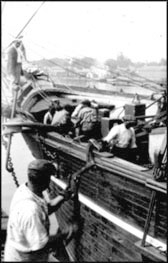
Seamen on the whaling bark Wanderer make ready to cast off for another voyage. The exact location is unknown, but probably New England.
Whaling: Opportunities for African Americans in a Hard Business

The whaling industry, centered until the 1870s in New Bedford, employed a large number of African Americans. This was in part due to the Quaker tradition of tolerance in the New Bedford area, but more importantly, to the large demand for manpower in an expanding industry requiring unusually large crews.

Some black seamen in the business were Americans, from the Northeast and the South, some were from the West Indies, and a significant group was from the Cape Verde Islands off the African coast. Whatever their origin, black seamen found acceptance as hard workers and skilled mariners in an industry that was physically demanding, dirty, and often financially unrewarding.

When the center of the industry moved to San Francisco in the 1870s, African Americans continued to form a large percentage of the crews. The whaling business was no doubt the largest employer of African Americans seamen on the West Coast until it ended shortly before World War I.


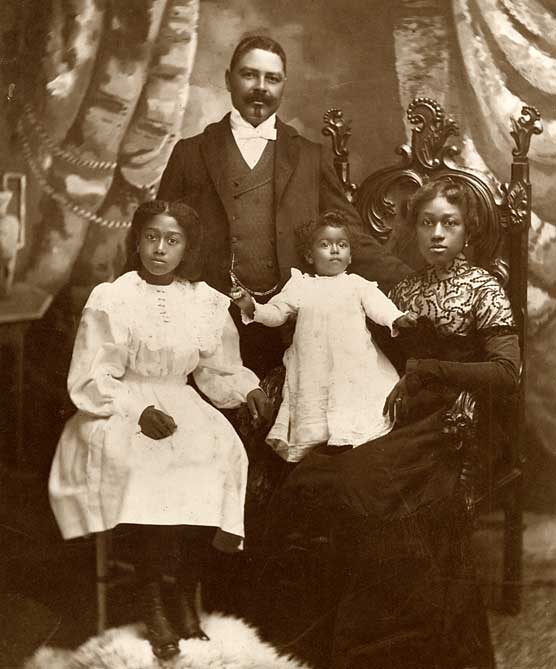
NPS  Captain William T. Shorey and family.
                                                

William T. Shorey (1859-1919) was a famous captain in the last days of whaling. He was born in Barbados, the son of a Scottish sugar planter and an Indian creole woman. Shorey began seafaring as a teenager and in 1876 he made his first whaling voyage.

Whaling brought him to California and he married the daughter from a leading African American family in San Francisco. In 1886 he became the only black West Coast ship captain. Known for his skill and leadership, Shorey experienced many adventures and dangers at sea with multiracial crews before his retirement in 1908.

Over time, larger, steam-powered vessels took the place of obsolete sailing ships and black seamen were forced to accept inferior employment on ships as cooks and stewards. The era of significant participation by blacks in whaling ended in 1923 when the Wanderer went aground off Nantucket, MA.


Black Men in Foreign Flag Sailing Ships

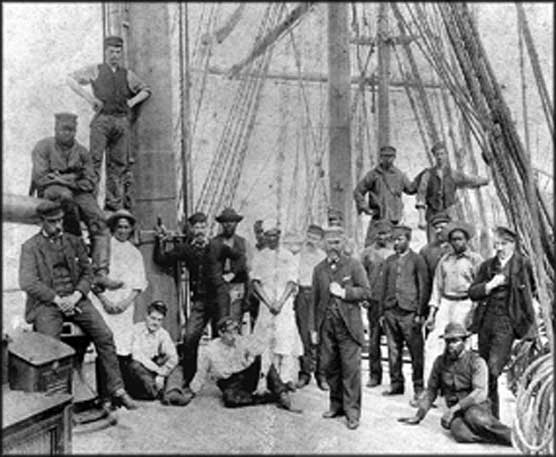
The crew of the British ship Rathdown,
photographed in San Francisco in 1892.
The two men in aprons are the cook  and
 steward but the other black men are all seamen.


Black men were often found among the crews of British ships, and even some German and Scandinavian ships, calling at West Coast ports. Black faces appear in about one quarter of all the foreign flag crew photographs in the park's collections. In many cases the men are clearly cooks or stewards, but in a surprising number of photos the men are obviously seamen, living and working on terms of complete equality with other members of the crew. The majority of black seamen in British ships were probably from the West Indies, but we do not have references for African Americans hired as seamen in foreign ships at New York and other East Coast ports.


The Navy: A Mixed Legacy
Throughout most of its history, the Navy has followed a policy of employing African Americans in all enlisted grades. They were active in both naval and privateer crews during the Revolutionary War. A brief period of discrimination ended with the War of 1812. From then until 1915 African Americans served in the ranks of all naval vessels. During the Civil War, at least six African Americans were awarded the Congressional Medal of Honor. Only officer ranks were closed to them during this period.
In 1915 an executive order from President Wilson ordered segregation for all branches in the military. Until 1942 African Americans were recruited only as messmen. During the rest of World War II, opportunities for African Americans gradually expanded and the first twelve officers were commissioned in 1944. In 1946 a Navy order finally ended official segregation throughout the Navy.
 Desegregation in practice took somewhat longer to achieve, but was finally accomplished, and today the Navy can once again take pride in its tradition of racial equality.


NPS
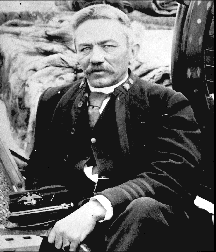
Captain Michael Healy of the Revenue Cutter Bear.
Although the Navy had no commissioned officers in the 19th century, this restriction did not hold for the Revenue Service, the predecessor of the modern Coast Guard.
Captain Healy, an African American, rose to the rank of Captain in 1883. From 1886 until 1895 Healy commanded the Bear, a steam barkentine, on patrols in the North Pacific, Bering Sea, and Arctic Ocean. The Bear was virtually the only law in these Northern regions, enforcing quotas in the sealing industry, protecting native people from exploitation, and keeping the peace among white settlers. She performed many feats of heroic rescue among the whaling fleet and the isolated outposts of trappers and hunters.
Captain Healy was known as a stern disciplinarian, and was accused of brutalizing his seamen on at least one occasion. Although formally exonerated from these charges, it is no doubt true that he was a hard man, performing a difficult and demanding duty.


This information thanks to the National Parks Service  (NPS)

Thursday, February 3, 2011

Black History Month 2011

See Ex-slave narratives

A Library of Congress Resource Guide for the Study of Black History & Culture


traces the graphic art made by Emory Douglas while he worked as minister of culture for the Black Panther Party from 1967 until its discontinuation in the early 1980s. Douglas's powerful visuals helped define the trademark visual style of the group's newspapers, posters, and pamphlets.

Click on each individual poster for an enlarged view and commentary.


Marion Anderson
 In 1939, the Daughters of the American Revolution (DAR) refused permission for Anderson to sing to an integrated audience in Constitution Hall. Their race-driven refusal placed Anderson into the spotlight of the international community on a level usually only found by high profile celebrities and politicians. With the aid of President Franklin D. Roosevelt and First Lady Eleanor Roosevelt, Anderson performed a critically acclaimed open-air concert on Easter Sunday, in 1939 on the steps of the Lincoln Memorial in Washington, D.C. to a crowd of more than 75,000 people and a radio audience in the millions.


Click here to see A short film about the life and career of singer Marian Anderson up through 1950.

Monday, January 17, 2011

MLK's Letter from Birmingham Jail - "A Call for Unity" (1963)

This video is over an hour long but don't let that deter you from watching it. Please take the time to view this video. Take the time to share it with with our young people, who may not be aware of its contents or the valor of those who struggled during those trying times. The struggle is not over and they will need the examples of doctor King and those of us who worked with him to hold themselves and the country accountable for the injustices that are still occuring.

"Freedom must be demanded by the oppressed."


"Justice too long delayed is justice denyed"

Saturday, November 27, 2010

Black Mother Black Daughter - Nova Scotia Women of Color

Black Mother Black Daughter


 Rose Fortune was almost certainly the daughter of "Fortune — a free Negro", who came to Nova Scotia after the American War of Independence. He appears with his wife and a "child above ten" (probably Rose) in the muster roll of Loyalists at Annapolis in June 1784.

 Rose earned her living as a trucker at Annapolis Royal. She carried baggage by a heavy wheelbarrow for the many passengers who travelled on the Saint John-Digby-Annapolis ferry. She also on occasion provided other assistance to travellers, such as helping them find better accommodation. Rose had two daughters and two grandsons. Family tradition states that one of her customers was Judge Haliburton, who came to Annapolis Royal to conduct court for the day. He relied on Rose to waken him the next morning and get him on board ship so that he would be in Digby in time to hold court there. (Noted author T.C. Haliburton was a judge of the Supreme Court, 1841-1856.)

 Along with the carting and wake up services, Fortune established curfews and standards of behavior on the wharf.  Her words of enforcement established her as the first police woman in Canada. She told stragglers to move along and to clear the streets before she turned in.

 Although suffering from severe rheumatism in her later years, Rose continued to work until well into her seventies.


Black Mother Black Daughter
An NFB film by Claire Prieto & Sylvia Hamilton,


This is a wonderful film that chronicles the lives of Black Nova Scotian Women and their contributions to their communities socially, economically and spiritually as well as politically. We meet mothers and daughters and learn from them about some of their life experiences  in their Nova Scotian communities.


Try this link (Click Here) if the embedded video is not available.

Wednesday, October 6, 2010

Claudia Jones The Black Woman that created London Carnival

Trinidadian Claudia Jones was a civil rights worker, refugee and journalist. She set up the first ever weekly West Indian paper and in 1959 in response to the racist riots of 1958 created the first ever carnival. She also campaigned against racist immigration and for decent housing for immigrants from the Commonwealth who had been invited to Britain by Enoch Powell

Claudia Jones 1


Claudia Jones 2


Claudia Jones 3

Monday, October 4, 2010

Excerpt from "The Negro Problem" P.L. Dunbar

Representative American Negroes
By PAUL LAURENCE DUNBAR


    An enumeration of some of the noteworthy American Negroes of to-day and yesterday, with some account of their lives and their work. In this paper Mr. Dunbar has turned out his largest and most successful picture of the colored people. It is a noble canvas crowded with heroic figures.

In considering who and what are representative Negroes there are circumstances which compel one to question what is a representative man of the colored race. Some men are born great, some achieve greatness and others lived during the reconstruction period. To have achieved something for the betterment of his race rather than for the aggrandizement of himself, seems to be a man's best title to be called representative. The street corner politician, who through questionable methods or even through skillful manipulation, succeeds in securing the janitorship of the Court House, may be written up in the local papers as "representative," but is he?

I have in mind a young man in Baltimore, Bernard Taylor by name, who to me is more truly representative of the race than half of the "Judges," "Colonels," "Doctors" and "Honorables" whose stock cuts burden the pages of our negro journals week after week. I have said that he is young. Beyond that he is quiet and unobtrusive; but quiet as he is, the worth of his work can be somewhat estimated when it is known that he has set the standard for young men in a city that has the largest colored population in the world.

It is not that as an individual he has ridden to success one enterprise after another. It is not that he has shown capabilities far beyond his years, nor yet that his personal energy will not let him stop at one triumph. The importance of him lies in the fact that his influence upon his fellows is all for good, and in a large community of young Negroes the worth of this cannot be over-estimated. He has taught them that striving is worth while, and by the very force of his example of industry and perseverance, he stands out from the mass. He does not tell how to do things, he does them. Nothing has contributed more to his success than his alertness, and nothing has been more closely followed by his observers, and yet I sometimes wonder when looking at him, how old he must be, how world weary, before the race turns from its worship of the political janitor and says of him, "this is one of our representative men."

This, however, is a matter of values and neither the negro himself, his friends, his enemies, his lauders, nor his critics has grown quite certain in appraising these. The rabid agitator who goes about the land preaching the independence and glory of his race, and by his very mouthings retarding both, the saintly missionary, whose only mission is like that of "Pooh Bah," to be insulted; the man of the cloth who thunders against the sins of the world and from whom honest women draw away their skirts, the man who talks temperance and tipples high-balls—these are not representative, and whatever their station in life, they should be rated at their proper value, for there is a difference between attainment and achievement.

Under the pure light of reason, the ignorant carpet bagger judge is a person and not a personality. The illiterate and inefficient black man, whom circumstance put into Congress, was "a representative" but was not representative. So the peculiar conditions of the days immediately after the war have made it necessary to draw fine distinctions.

When Robert Smalls, a slave, piloted the Confederate ship Planter out of Charleston Harbor under the very guns of the men who were employing him, who owned him, his body, his soul, and the husk of his allegiance, and brought it over to the Union, it is a question which forty years has not settled as to whether he was a hero or a felon, a patriot or a traitor. So much has been said of the old Negro's fidelity to his masters that something different might have been expected of him. But take the singular conditions: the first faint streaks of a long delayed dawn had just begun to illumine the sky and this black pilot with his face turned toward the East had no eye for the darkness behind him. He had no time to analyze his position, the right or wrong of it. He had no opportunity to question whether it was loyalty to a union in which he aspired to citizenship, or disloyalty to his masters of the despised confederacy. It was not a time to argue, it was a time to do; and with rare power of decision, skill of action and with indomitable courage, he steered the good ship Planter past Fort Johnson, past Fort Sumter, past Morris Island, out where the flag, the flag of his hopes and fears floated over the federal fleet. And Robert Smalls had done something, something that made him loved and hated, praised and maligned, revered and despised, but something that made him representative of the best that there is in sturdy Negro manhood.

It may seem a far cry from Robert Smalls, the pilot of the Planter, to Booker T. Washington, Principal of the Institute at Tuskegee, Alabama. But much the same traits of character have made the success of the two men; the knowledge of what to do, the courage to do it, and the following out of a single purpose. They are both pilots, and the waters through which their helms have swung have been equally stormy. The methods of both have been questioned; but singularly neither one has stopped to question himself, but has gone straight on to his goal over the barriers of criticism, malice and distrust. The secret of Mr. Washington's power is organization, and organization after all is only a concentration of force. This concentration only expresses his own personality, in which every trait and quality tend toward one definite end. They say of this man that he is a man of one idea, but that one is a great one and he has merely concentrated all his powers upon it; in other words he has organized himself and gone forth to gather in whatever about him was essential.

Pilot he is, steadfast and unafraid, strong in his own belief,—yes strong enough to make others believe in him. Without doubt or skepticism, himself he has confounded the skeptics.

Less statesmanlike than Douglass, less scholarly than DuBois, less eloquent than the late J.C. Price, he is yet the foremost figure in Negro national life. He is a great educator and a great man, and though one may not always agree with him, one must always respect him. The race has produced no more adroit diplomatist than he. The statement is broad but there is no better proof of it than the fact that while he is our most astute politician, he has succeeded in convincing both himself and the country that he is not in politics. He has none of the qualities of the curb-stone politician. He is bigger, broader, better, and the highest compliment that could be paid him is that through all his ups and downs, with all he has seen of humanity, he has kept his faith and his ideals. While Mr. Washington stands pre-eminent in his race there are other names that must be mentioned with him as co-workers in the education of the world, names that for lack of time can be only mentioned and passed.

W.H. Council, of Normal, Alabama, has been doing at his school a good and great work along the same lines as Tuskegee. R.R. Wright, of the State College of Georgia, "We'se a-risin' Wright," he is called, and by his own life and work for his people he has made true the boyish prophecy which in the old days inspired Whittier's poem. Three decades ago this was his message from the lowly South, "Tell 'em we'se a-risin," and by thought, by word, by deed, he has been "Tellin' em so" ever since. The old Southern school has melted into the misty shades of an unregretted past. A new generation, new issues, new conditions, have replaced the old, but the boy who sent that message from the heart of the Southland to the North's heart of hearts has risen, and a martyred President did not blush to call him friend.

So much of the Negro's time has been given to the making of teachers that it is difficult to stop when one has begun enumerating some of those who have stood out more than usually forceful. For my part, there are two more whom I cannot pass over. Kelly Miller, of Howard University, Washington, D.C., is another instructor far above the average. He is a mathematician and a thinker. The world has long been convinced of what the colored man could do in music and in oratory, but it has always been skeptical, when he is to be considered as a student of any exact science. Miller, in his own person, has settled all that. He finished at Johns Hopkins where they will remember him. He is not only a teacher but an author who writes with authority upon his chosen themes, whether he is always known as a Negro writer or not. He is endowed with an accurate, analytical mind, and the most engaging blackness, for which some of us thank God, because there can be no argument as to the source of his mental powers.

Now of the other, William E.B. DuBois, what shall be said? Educator and author, political economist and poet, an Eastern man against a Southern back-ground, he looms up strong, vivid and in bold relief. I say looms advisedly, because, intellectually, there is something so distinctively big about the man. Since the death of the aged Dr. Crummell, we have had no such ripe and finished scholar. Dr. DuBois, Harvard gave him to us, and there he received his Ph.D., impresses one as having reduced all life and all literature to a perfect system. There is about him a fascinating calm of certain power, whether as a searcher after economic facts, under the wing of the University of Pennsylvania, or defying the "powers that be" in a Negro college or leading his pupils along the way of light, one always feels in him this same sense of conscious, restrained, but assured force.

Some years ago in the course of his researches, he took occasion to tell his own people some plain hard truths, and oh, what a howl of protest and denunciation went up from their assembled throats, but it never once disturbed his magnificent calm. He believed what he had said, and not for a single moment did he think of abandoning his position.

He goes at truth as a hard-riding old English squire would take a difficult fence. Let the ditch be beyond if it will.

Dr. DuBois would be the first to disclaim the name of poet but everything outside of his statistical work convicts him. The rhythm of his style, his fancy, his imagery, all bid him bide with those whose souls go singing by a golden way. He has written a number of notable pamphlets and books, the latest of which is "The Soul of the Black Folk," an invaluable contribution to the discussion of the race problem by a man who knows whereof he speaks.

Dr. DuBois is at Atlanta University and has had every opportunity to observe all the phases of America's great question, and I wish I might write at length of his books.

It may be urged that too much time has already been taken up with the educational side of the Negro, but the reasonableness of this must become apparent when one remembers that for the last forty years the most helpful men of the race have come from the ranks of its teachers, and few of those who have finally done any big thing, but have at some time or other held the scepter of authority in a school. They may have changed later and grown, indeed they must have done so, but the fact remains that their poise, their discipline, the impulse for their growth came largely from their work in the school room.

There is perhaps no more notable example of this phase of Negro life than the Hon. Richard Theodore Greener, our present Consul at Vladivostok. He was, I believe, the first of our race to graduate from Harvard and he has always been regarded as one of the most scholarly men who, through the touch of Negro blood, belongs to us. He has been historian, journalist and lecturer, but back of all this he was a teacher; and for years after his graduation he was a distinguished professor at the most famous of all the old Negro colleges. This institution is now a thing of the past, but the men who knew it in its palmy days speak of it still with longing and regret. It is claimed, and from the names and qualities of the men, not without justice, that no school for the higher education of the black man has furnished a finer curriculum or possessed a better equipped or more efficient faculty. Among these, Richard T. Greener was a bright, particular star.

After the passing of the school, Mr. Greener turned to other activities. His highest characteristics were a fearless patience and a hope that buoyed him up through days of doubt and disappointment. Author and editor he was, but he was not satisfied with these. Beyond their scope were higher things that beckoned him. Politics, or perhaps better, political science, allured him, and he applied himself to a course that brought him into intimate contact with the leaders of his country, white and black. A man of wide information, great knowledge and close grasp of events he made himself invaluable to his party and then with his usual patience awaited his reward.

The story of how he came to his own cannot be told without just a shade of bitterness darkening the smile that one must give to it all. The cause for which he had worked triumphed. The men for whom he had striven gained their goal and now, Greener must be recognized, but—

Vladivostok, your dictionary will tell you, is a sea-port in the maritime Province of Siberia, situated on the Golden Horn of Peter the Great. It will tell you also that it is the chief Russian naval station on the Pacific. It is an out of the way place and one who has not the world-circling desire would rather hesitate before setting out thither. It was to this post that Mr. Greener was appointed.

"Exile," his friends did not hesitate to say. "Why didn't the Government make it a sentence instead of veiling it in the guise of an appointment?" asked others sarcastically.

"Will he go?" That was the general question that rose and fell, whispered and thundered about the new appointee, and in the midst of it all, silent and dignified, he kept his council. The next thing Washington knew he was gone. There was a gasp of astonishment and then things settled back into their former state of monotony and Greener was forgotten.

But in the eastern sky, darkness began to arise, the warning flash of danger swept across the heavens, the thunder drum of war began to roll. For a moment the world listened in breathless suspense, the suspense of horror. Louder and louder rose the thunder peal until it drowned every other sound in the ears of the nation, every other sound save the cries and wails of dying women and the shrieks of tortured children. Then France, England, Germany, Japan and America marshalled their forces and swept eastward to save and to avenge. The story of the Boxer uprising has been told, but little has been said of how Vladivostok, "A sea-port in the maritime Province of Siberia," became one of the most important points of communication with the outside world, and its Consul came frequently to be heard from by the State Department. And so Greener after years of patience and toil had come to his own. If the government had wished to get him out of the way, it had reckoned without China.

A new order of things has come into Negro-American politics and this man has become a part of it. It matters not that he began his work under the old regime. So did Judge Gibbs, a man eighty years of age, but he, too, has kept abreast of the times, and although the reminiscences in his delightful autobiography take one back to the hazy days when the land was young and politics a more strenuous thing than it is even now, when there was anarchy in Louisiana and civil war in Arkansas, when one shot first and questioned afterward; yet because his mind is still active, because he has changed his methods with the changing time, because his influence over young men is greatly potent still; he is, in the race, perhaps, the best representative of what the old has brought to the new.

Beside him strong, forceful, commanding, stands the figure of George H. White, whose farewell speech before the Fifty-sixth Congress, when through the disfranchisement of Negroes he was defeated for re-election, stirred the country and fired the hearts of his brothers. He has won his place through honesty, bravery and aggressiveness. He has given something to the nation that the nation needed, and with such men as Pinchback, Lynch, Terrell and others of like ilk, acting in concert, it is but a matter of time when his worth shall induce a repentant people, with a justice builded upon the foundation of its old prejudice, to ask the Negro back to take a hand in the affairs of state.

Add to all this the facts that the Negro has his representatives in the commercial world: McCoy and Granville T. Woods, inventors; in the agricultural world with J.H. Groves, the potato king of Kansas, who last year shipped from his own railway siding seventy-two thousand five hundred bushels of potatoes alone; in the military, with Capt. Charles A. Young, a West Pointer, now stationed at the Presidio; that in medicine, he possesses in Daniel H. Williams, of Chicago, one of the really great surgeons of the country; that Edward H. Morris, a black man, is one of the most brilliant lawyers at the brilliant Cook County bar; that in every walk of life he has men and women who stand for something definite and concrete, and it seems to me that there can be little doubt that the race problem will gradually solve itself.

I have spoken of "men and women," and indeed the women must not be forgotten, for to them the men look for much of the inspiration and impulse that drives them forward to success. Mrs. Mary Church Terrell upon the platform speaking for Negro womanhood and Miss Sarah Brown, her direct opposite, a little woman sitting up in her aerie above a noisy New York street, stand for the very best that there is in our mothers, wives and sisters. The one fully in the public eye, with learning and eloquence, telling the hopes and fears of her kind; the other in suffering and retirement, with her knowledge of the human heart and her gentleness inspiring all who meet her to better and nobler lives. They are both doing their work bravely and grandly. But when the unitiate ask who is "la Petite Reine," we think of the quiet little woman in a New York fifth floor back and are silent.

She is a patron of all our literature and art and we have both. Whether it is a new song by Will Marion Cook or a new book by DuBois or Chestnut, than whom no one has ever told the life of the Negro more accurately and convincingly, she knows it and has a kindly word of praise or encouragement.

In looking over the field for such an article as this, one just begins to realize how many Negroes are representative of something, and now it seems that in closing no better names could be chosen than those of the two Tanners.

From time immemorial, Religion and Art have gone together, but it remained for us to place them in the persons of these two men, in the relation of father and son. Bishop Benj. Tucker Tanner, of the A.M.E. Church, is not only a theologian and a priest, he is a dignified, polished man of the higher world and a poet. He has succeeded because he was prepared for success. As to his writings, he will, perhaps, think most highly of "His Apology For African Methodism;" but some of us, while respecting this, will turn from it to the poems and hymns that have sung themselves out of his gentle heart.

Is it any wonder that his son, Henry O. Tanner, is a poet with the brush or that the French Government has found it out? From the father must have come the man's artistic impulse, and he carried it on and on to a golden fruition. In the Luxembourg gallery hangs his picture, "The Raising of Lazarus." At the Academy of Fine Arts, Philadelphia, I saw his "Annunciation," both a long way from his "Banjo Lesson," and thinking of him I began to wonder whether, in spite of all the industrial tumult, it were not in the field of art, music and literature that the Negro was to make his highest contribution to American civilization. But this is merely a question which time will answer.

All these of whom I have spoken are men who have striven and achieved and the reasons underlying their success are the same that account for the advancement of men of any other race: preparation, perseverance, bravery, patience, honesty and the power to seize the opportunity.

It is a little dark still, but there are warnings of the day and somewhere out of the darkness a bird is singing to the Dawn.

Sunday, October 3, 2010

The African British Experience

British Born Jamaican, Delroy Constantine-Simms
penned this article for "The Black Commentator"
in the March 1, 2007 issue.
Here's some of what he said. Read more for further insight into the "Black British" experience.


The majority of Africans in the Diaspora still suffer a lack of knowledge of self and our past and as a result suffer from cultural disinheritance. Historically this has lead to the internalisation and feelings of an inferiority complex, which are a direct result of becoming caricatures and an inferior subset of the human race in the body of Western thought.

Nowhere else in the world does Black History include the celebration of other cultures’ history that is not of African (and Caribbean) Origin. The British approach to Black History Month may be seen as inclusive to many, but to me it effectively challenges and undermines the reason why Black History Month was initially conceived. This urbanisation of Black History Month represents the watering down and marginalisation of our history and significant contribution to British society post and pre the Windrush.

In the USA, Black means anybody that is of African heritage; usually referring to Africans, African-Americans, Caribbean and African South Americans and those who identify with the Black experience but may be of dual heritage. No one else! Blacks in Britain have to accept footnote politics in that the definition of Black has to be explained on most public documents aimed at the so called target group. It's laughable, but a fact of British politics. It's no wonder African-Americans don't take us seriously as a community. It's no wonder they are confused when the come to UK Black History events only to find that the History being discussed has nothing to do with the African Diaspora experience. It's easy to blame the local authorities and national government, and mainstream for this state of affairs. But in reality, misguided Black politicians of the late 1970's with strong socialist tendencies created a situation where Black political and socio-historical contributions to the United Kingdom have been marginalised, recast and re-labelled as an urban contribution to the delight of organisations and policy makers who have no interest in accepting the term Black, let alone the contribution of Blacks in the United Kingdom before the arrival of the Windrush and after!

Sunday, May 9, 2010

Descendants of freed slaves fight to keep historic black church


Descendants of freed slaves fight to keep historic black church
Originally published February 28, 2010


By Ron Cassie
News-Post Staff


In 1878, near Jefferson , Md., in one of the state's first communities founded by freed slaves, African-American citizens bought the land where they soon built their own "colored" school, church and cemetery.
The first church services were held in the schoolhouse in the mid-1880s. In 1899, members erected the simple, wooded-framed, steepled Sunnyside Methodist Episcopal Church that still stands. The school remained in use until desegregation.

Today, descendants of those freed slaves, the 30 remaining members of the congregation, are fighting the United Methodist Church in court to keep possession of the historic church, the former school, a community hall now and the cemetery where more than 100 of their ancestors are buried.

 In late 2008, in a dispute over the church's future and its increasing apportionment payments, the Sunnyside flock renounced its affiliation with the United Methodist Church. Hoping to reorganize as an independent, Bible-centered community church, congregation board members are now defendants in a court action brought by the Baltimore-Washington Conference of the United Methodist Church for failing to vacate the church grounds.

The one-acre property is valued at $150,000, according to the Maryland Department of Assessments and Taxation.

  (read complete article)

Sunday, March 21, 2010

"Queen Mother" Audley E. Moore


"Queen Mother" Audley Moore


Queen Mother Audley E. Moore

In Honor Of A Warrior Woman


On December 6 and 7, 1991, the Department of Pan-African Studies at Kent State University dedicated the entire third floor of the Center of Pan-African Culture to Queen Mother Audley E. Moore, a "Warrior Woman," born on July 27, 1898, who devoted her life to active struggle on behalf of all people of African descent. She was honored for having organized on many fronts, from the great influenza epidemic of 1918 in Muscle Shoals, Alabama, where she worked as a volunteer nurse, to the United Nations, where she presented petitions in the 1950s charging genocide and demanding reparations to descendants of former slaves. 

She was born as Audley to Ella and St. Cry Moore on July 27, 1898 in New Iberia, Louisiana. Her grandmother, Nora Henry, was born into slavery, the daughter of an African woman who was raped by her slave master who was a doctor. Her grandfather was lynched before his wife's eyes leaving Nora Henry with five orphaned children of whom Ella Johnson — mother of Queen Mother Moore — was the youngest. Ella died in 1904. 

Queen Mother Moore completed only the third grade of her formal education. Her struggles began at the tender age of twelve fighting the advances of white men in the South . . . Queen Mother has been struggling for seventy-seven years for the human and civil rights of all African people throughout the world which makes her our warrior queen and a living legend. At the grand old age of ninety-eight, she continues to make her home in Harlem.

Some of her efforts — to help our struggle to take us towards self-determination, acquisition of our inheritance in Africa and our just claim for reparations from the United States government — are documented below: 

The founder and president of the Universal Association of Ethiopian Women, she is a life member of both the Universal Negro Improvement Association and the National Moorish Council of Negro Women. She joined Marcus Mosiah Garvey's Universal Negro Improvement Association and African Communities League (UNIA) while living in Louisiana. She participated in Garvey's first international convention in New York City, owned stock in the Black Star Line, and came to New York when the UNIA launched the Black Star Line's first ship.
She is President-General, World Federation of African People, Inc. She is founder and president of the Universal Association of Ethiopian Women, Inc. which led a successful fight to restore 23,000 families to the welfare rolls after they had been ruthlessly cut off by Louisiana authorities. She is the founder of the Committee for Reparations for Descendants of U.S. Slaves. She is a founding member of the Republic of New Africa to fight for self-determination, land, and reparations. She is founder of Mt. Addis Ababa, Inc., envisioned as a facility to totally embrace the cultural, educational, and industrial needs of her people. Through Mr. Roscoe Bradley, her executive vice president, this organization, located at Mt. Addis Ababa, Box 244, Parksville, NY 12768, taught hundreds of children African music, dance, and culture.

She is Bishop of the Apostolic Orthodox Church of Judea. She is a founding member of the Commission to Eliminate Racism, Council of Churches of Greater New York. In organizing this commission, she staged a twenty-four-hour sit-in for three weeks. She is a founder of the African American Cultural Foundation, Inc., which led the fight against usage of the slave term "Negro."

She joined the Republican Party, found them racist, left and joined the Communist Party to fight the Scottsboro Boys' imprisonment. She led the fight to end Jim Crow in big league baseball. She organized the community with Captain Hugh Mulzac as chairman and the Reverend Adam Clayton Powell, Jr. as co-chairman. Later realizing the fallacy in this, she apologized to her people. She resigned from the Communist Party in disillusionment after they changed their position on self-determination in the South's Black Belt.

She led protests against the Apollo Theatre for showing racist shows and led protests against the Alhambra Theatre for showing a white man as Hannibal. She helped organize CIO unions and the Work Progress Administration. She forced the WPA to employ black women on sewing projects who were previously relegated to domestic work. She also tried to organize a domestic workers union. She was arrested three times during her struggle-first for defending the rights of our children to use the public Colonial Park pool without bringing along their birth certificates; another time for defending a peddler from arrest for selling tomatoes to support his seven little children; the third time for trying to register people to vote in Green County, New York.
She led the fight with Assemblyman William Andrews, the Reverend Ethelring Brown, and Ludlow Werner to get a congressional district in Harlem in the 1930s. She helped to organize the Maritime Union under Ferdinand Smith. She also led the fight to break Jim Crow policy in the Coast Guard and became the first black stewardess to be hired. She helped stranded seamen in London and held a mass meeting in 1946 in a hotel lobby in London for the management's refusal of accommodations due to racism. She campaigned for medical aid and funds for Ethiopia after the Italians attacked. She organized 500 nurses to sterilize sheets which were collected from laundries for bandages for the wounded Ethiopian soldiers.
She investigated the condition of our little girls, ages twelve to fourteen, who gave birth while in a mental institution in Louisiana. The girls had been raped by their white male attendants. She was encouraged by Dr. A.L. Reddick and Dr. Mary McLeod Bethune, both of whom were eminent educators, to take to public speaking in defense of her people's liberty. Before this she only spoke at street meetings from a box or a ladder on the corner of 125th Street and 7th Avenue. She organized the first rent strike on Sugar Hill in 1930 and restored tenants to their apartments after having been evicted. She supported the Mau Mau rebellion in Kenya and took a delegation to the British Embassy to protest the ultimatum given to the Mau Mau to surrender or be annihilated.

She fought to save from execution the Martinville Seven and helped to organize street meetings and demonstrations. She helped to free Mae Mallory imprisoned for defending herself from an attack of the KKK in Monroe, North Carolina. She presented a petition to the United Nations in 1957 for self-determination and against genocide. She presented a second petition in 1959 to the United Nations for land and reparations. She toured throughout the country by car in 1962 begging gas from gas station to gas station to alarm our people to prepare for our Emancipation Proclamation Centennial by presenting a judicial document for reparations and self-determination proclaiming us a non-self-governing nation.

She organized a soup kitchen in Harlem for African students after learning two students had died from malnutrition after they received their Ph.D. She also helped to organize Africa House in New York City with Mrs. Mattie Hunter for African students. She participated in the North American Regional Planning Conference (held at Kent State University in 1973) leading up to the Sixth Pan-African Congress. In 1974, she attended this international Congress in Dar-es-Salaam, Tanzania. This Congress was the first ever international meeting of African people held on the soil of Mother Africa. She, at the request of Dr. Mary McLeod Bethune, became a life member of the National Council of Negro Women. She is the founder and president of the Harriet Tubman Association. She helped to organize the Unemployed Councils when millions were on the brink of starvation. She presented a demand for reparations to President Kennedy which caused him to say: "Ask not what this country can do for you, but what you can do for it."
As mentioned earlier, the above represents only "some" of the activities in which Queen Mother Moore has been involved for the past seventy or more years. We are, therefore, very much honored to have her in our presence and to take time out to honor this great African Warrior Woman. 
Unfortunately, Queen Mother Audley E. Moore, a life-long "Warrior Woman," died on May 2, 1997, at the age of 99. We will miss her. May she rest in eternal peace. 

SOURCE: This "Biographical Data" was prepared by the Honorable Dr. Deloise Naewoaang Blakely, Deputy Mayor of Harlem, New York, 1993.


Reparations, Queen Mother Moore
Interview - Part 1


Reparations, Queen Mother Moore
Interview - Part 2 www.queenmothermoore.org  


Those who seek temporary security rather than basic liberty deserve neither... 
Queen Mother Moore


Thursday, February 11, 2010

The BlackPast.org website

If you want to stay at the head of the class for
Black History Month and the rest of the year,


Thousands of pages of Black History a mouse click away.

  • African American History
  • African American History in the West
  • Global African History

Lots of photos but limited audio files thus far.

"BlackPast.org, an online reference center makes available a wealth of materials on African American history in one central location on the Internet. These materials include an online encyclopedia of over 1,500 entries, the complete transcript of over 125 speeches given between 1789 and 2008, over 100 full text primary documents, bibliographies, timelines and four gateway pages with links to 50 digital archive collections. Additionally 75 major African American museums and research centers and over 400 other website resources on black history are also linked to the website. The compilation and concentration of these diverse resources allows BlackPast.org to serve as the "Google" of African American history."

"BlackPast.org (www.blackpast.org) began in January 2004 as an online reference center in African American history when Quintard Taylor, the Scott and Dorothy Bullitt Professor of American History at the University of Washington, and his graduate assistant, George Tamblyn, placed on his faculty website various reference materials which described historical figures and events discussed in Taylor’s class lectures. Soon afterwards they added a bibliography, a timeline, and links to other internet sites that presented or discussed various aspects of the black historical experience."

Wednesday, February 10, 2010

The Pullman Porter the Vanguard of the Black Middle Class


While it might be difficult for us to imagine today, at one time the job of Pullman Porter was very highly prized and carried with it a quite a bit of status in the Black community.


In order to get a taste of the social history of a Pullman porter
listen to the attached NPR broadcast titled
by journalist Larry Tye. Tye says that the job was one of the best for African Americans at the time, and that it was a foothold in the American workplace.

An interview with a former Pullman porter.


Monday, February 1, 2010

African History by Basil Davidson Pt. 1

I collected this interesting series on youtube.

Basil Davidson (born 9 November 1914 in Bristol, England) is an acclaimed British historian, writer and Africanist, particularly knowledgeable on the subject of Portuguese Africa prior to the 1974 Carnation Revolution .

He has written several books on the current plight of Africa. Colonialism and the rise of African emancipation movements have been central themes of his work.


Since 1951, he became a well known authority on African history, an unfashionable subject in the 1950s. His writings have emphasised the pre-colonial achievements of Africans, the disastrous effects of the Atlantic Slave Trade, the further damage inflicted on Africa by European colonialism and the baleful effects of the Nation State in Africa.

Davidson's works are required reading in many British universities. He is globally recognized as an expert on African History.

He currently lives in Staffordshire

1 Different but Equal

Basil Davidson

2 Mastering a Continent


3 Caravans of Gold


4 The King & The City


5 The Bible & The Gun


6 The Magnificent African Cake


7 The Rise of Nationalism


8 The Legacy


Tuesday, January 12, 2010

Glen Beck said: "African-American is a bogus, PC, made-up term.


Beck: "African-American is a bogus, PC, made-up term. I mean, that's not a race"

What did Beck say?


I just happened to listen to Smokey Robinson the other day, on the same topic.

What did Smokey say?

A Black American - Def Poetry Jam


While we're on the topic:

What did Carlos say?


Now what game is the government playing exactly?


What do you say?

Tuesday, January 5, 2010

Afrocentric history. Drusilla Dunjee Houston


BIOGRAPHY: Drusilla Dunjee Houston (1876-1941)

In 1999, the Uncrowned Queens Institute for Research and Education on Women, Inc. was established in Buffalo, New York in honor of Drusilla Dunjee Houston. The Institute is named after Houston’s 1917 poem entitled America’s Uncrowned Queens. Like many African American women writers swallowed up and languishing in the historical gap, Houston is one of the most prolific and all but forgotten African American women writers of the 20th century. Considered a “historian without portfolio” and dismissed as a serious historian and writer by leading Black male historians of Post Emancipation and the Harlem Renaissance, e.g., W.E.B. DuBois, Alaine Locke, Carter G. Woodson and others, Houston burst on the historical literary scene in 1926 with Volume I of her magnum opus Wonderful Ethiopians of the Ancient Cushite Empire Book 1: Nations of the Cushite Empire, Marvelous Facts from Authentic Records thought to represent the crowning achievement of Drusilla Dunjee Houston’s literary life. Houston is remembered as the earliest known and possibly the only African American woman to write a multi-volume study of ancient Africa where she unapologetically proclaimed in 1926, an African origin of civilization and culture during one of the most turbulent periods for black Americans in American history.


Wonderful Ethiopians

of the

Ancient Cushite Empire

by Drusilla Dunjee Houston


PREFACE.
THE ORIGIN OF CIVILIZATION.

The minds of men today are stirred with eager questionings about the origin of civilization and about the part the different races of mankind played in its development from primitive. ages. The remains that archaeologists are uncovering in Egypt, old Babylonia, and South America, reveal that there were significant factors in the first development of the arts and sciences that history has failed to make clear. Scientists are busy today studying the types of those old civilizations and comparing them with those of the present. Our modern systems do not function for the masses to give them development and happiness as did some of the ancient cultures. Books upon the early life of man are very hard to secure. Few have been written that are authentic, because it requires technical skill to assemble and condense such matter. Exhaustive research work is necessary to secure this kind of information, with only a line here and there in modern books to help the reader to reach definite conclusions. Only the trained mind holds the multitude of details and possesses the ability to impartially weigh and classify the facts, that prove the influence of the races upon the civilization of today.

The quest for the innumerable and startling facts of the succeeding volumes arose, much as

p. 2

did the motive of Schliemann to seek the buried ruins of Troy, from the oft repeated expression found by the author in research work, that "what the ancients said about the Ethiopians was fabulous." Curiosity was aroused to go back over the story of the ancients to agree or draw new conclusions. The finds were so astonishing that the vow was made to spend upon this study many years if necessary. Like the "Quest of the Holy Grail" the aim became sacred, for the trail led backward into the heart of all that the world holds most precious and to the primal roots from which all culture sprang. At first the reading of an afternoon in the average public library would hardly reveal a line to the credit of the Ethiopian. Sometimes a ten volume set of modern books might yield only a few paragraphs; but the vow and the richness of the finds, gleaming like diamonds, led the eager searcher on. The trail was followed into the dry dusty books of the ancients, where the path widened and truth was revealed that will answer some of the baffling problems of civilization today. Here were missing links of the chain of culture vainly sought for elsewhere.

Our story will deal with the ancient Cushite empire of Ethiopians, that covered three continents and held unbroken sway for three thousand years. We will visit old Ethiopia, where as Herodotus said, "the gods delighted to banquet with the pious inhabitants." We will study the land and the ancient race. The "Old Race," will next win our attention, that Petrie found in Egypt of distinct and unique culture, who were the people

of the earlier and superior civilization of the first dynasties. Down through this prehistoric vista we see "Happy Araby" with her brilliant primitive culture and her unrivalled literature of later days. On the screen flashes the rich and surpassing culture of old Chaldea, which belonged to the ancient Cushite empire of Ethiopians. Next comes veiled and mysterious India, the scene of charming story and magic fable, with her subtle mysticism and philosophy. Tarrying a while with the conquest and life of the ancient Medes and Persians, the trail runs far afield into the dominions of Western Europe and the striking questions array themselves demanding to be answered. Who were the Celts? Who were the Teutons? and what was the origin of the so-called Aryan race? The author was as much astounded as will be the reader, as to what this study reveals. It leaves us wondering if there is any Aryan race.

We learn in the study of the races of Western Europe, to understand the hatreds of Europe that underlaid the world war. We learn that when the Celt and Teuton call the Ethiopians of the new world "Uncle" and "Auntie," they are using titles that are scientifically true. Our story passes on to another remnant of the ancient Cushite empire, that baffling race, the Iberians, now represented by the Basques; then to the Berbers of North Africa,. another branch of the Cushite race. Some scientists have called them the descendents of the "People of Atlantis." Next succeed the singular facts about the life of the mysterious Etruscans of old Italy who were the

p. 4

teachers of the Romans; then we follow the life and tragedy of the fleeting Pelasgians, who were the fountain out of which later Greek culture welled. They were the people of the legends of Greek mythology. It is almost impossible to find anything but scanty fragments in the world's literature about any of these people of pre-historic days, but our text has compiled these fragments, so many of them, as to form fascinating chapters. Today all of these subjects remain unexplained mysteries in the average book. We dwell for a while on the marvels of the lost civilization of the Ægean and stop to study the Greece of Homer and the meaning of the Greek legends. All having direct relation to the ancient Cushites.

Historic Greece in all her glory, but viewed from new angles, passes before us with the older and superior civilization of Asia Minor, which has been almost entirely overlooked in modern literature. Next we come to the fact that the Phoenicians called themselves Ethiopians and that the Hebrew writers gave them the same name; then we reflect upon the strange relationship of the family of Cushite tongues to the so-called Indo-European group of languages. The trail leads us high up to where we get a breathless view of the astounding Ethiopian religion, which gives us the answer to many strange and incomprehensible traits in the Ethiopian of today. Next follows the chapter on the "Wonderful Ethiopians," who produced fadeless colors that have held their hues for thousands of years, who drilled through solid rock and were masters

p. 5

of many other lost arts and who many scientists believe must have understood electricity, who made metal figures that could move and speak and may have invented flying machines, for the "flying horse Pegasus" and the "ram of the golden fleece" may not have been mere fairy tales. Next out of the forgotten wastes of the dark continent rise before us ancient African empires, representing other civilizations of the time of the Cretan age. Then across the screen comes flashing the "Ancient Cushite Trade Routes," which contrary to our notion were the medium by which rich and varied products were interchanged.

In the chapter on "Ancient Cushite Commerce," we follow the ships of these early, daring and skillful seamen, who before the dawn of history had blazed out the ocean trails that the Phoenicians later followed. We find irrefutable evidence of the presence of these daring conquerors in the primitive legends, religion and institutions of America. Next out of the dim haze of far antiquity, rise the indistinct lines of "Atlantis of Old," the race that gave civilization to the world, the race that tamed the animals and gave us domestication of plants. The gods of the ancient world were the kings and queens of mystic "Atlantis." The chapter the "Gods of Old" makes plain that the deities of Greece and Rome were also the kings and queens of the ancient Cushite empire of the Ethiopians, which was either the successor of the most famous branch of the Atlantic race. It was about these princes

p. 6

and heroes that all the wonderful mythology of the ancients was woven. They were the deities that were worshipped in India, Chaldea, Egypt, and in Greece and Rome, which nations themselves must have been related to the race of Atlantis, that tradition said had been overwhelmed by the sea. Atlantis could not have been mythical, for her rulers were the subjects of the art and literature of all the primitive nations until the fall of Paganism long after the birth of Christ.

Another division of Atlantis was trans-Atlantic America. There the mysterious Mound Builders represent the ancient Cushite race. We study the peculiar culture and genius of the fierce Aztec, who acknowledged that he received the germs of civilization from the earlier Cushite inhabitants. We pass southward and examine the higher development of the wonderful Mayas of North America, whose ruins are attracting special study today and we find there transplanted the Cushite arts of the ancient world. Next flash the pictures of the marvelous culture and arts of the Incas, superior to those of Western Europe in 1492. From America the story turns to the "Bronze and Iron Ages," we seek the origin of the mysterious bronze implements of Western Europe found in the hands of seemingly barbarous people. We seek for the place and the race that could have given the world the art of welding iron. The trail reveals that the land of the "Golden Fleece" and the garden of the "Golden Apples of Hesperides" were but centers of the ancient race, that as Cushite Ethiopians

p. 7

had extended themselves over the world. These are subjects that have attracted the study of world scholarship. They represent not mere myths but are all that vast ages have left to us of events of primitive race history. "Cushite Art" and "The Heart of the African" answer many questionings of our hearts about Ethiopians. The series closes with a comparison of ancient culture with modern forms. The intelligence of the Cushite, his original genius is held up beside the decadence of true ideals in the art and literature of the present. The "Revolt of Civilization" and "Dawn of a new World" voice the concern of the thoughtful over the present decay of culture.

We are sending forth this information because so few men today understand the primitive forces that are the root of modern culture. So superficial and prejudiced has been most modern research, that many important and accepted theories of universal history have no actual basis in fact. The average modern historical book contradicts what the ancients said about the nations. that preceeded them. We cannot solve the stupendous problems that the world faces, until we can read aright the riddle of the evolution of the races. Uninformed men make unsafe leaders. that is the primal cause for so many errors of judgment in state and national councils. We look upon them not as statesmen but as promoters of petty politics, for out of their deliberations spring no alleviation of the woes of the world. It is from this lack of understanding in leadership

p. 8

that the world suffers most today. We could discriminate between the true and false in our civilization, if we knew more about primitive culture. The way by which the first man climbed must ever be the human way. Racial prejudices are the greatest menace to world progress. Classes clash because the wealth of the world concentrates more and more in the hands of a few. The tragedy of human misery increases, the increase of defectives, the growing artificiality of modern living, compels us to seek and blazen forth the knowledge of the true origin of culture and the fundamental principles that through the ages have been the basis of true progress. Only by this wisdom shall we know how to lift human life today.

In most modern books there seems to be preconcerted understanding to calumniate and disgust the world with abominable pictures of the ruined Ethiopian, ruined by the African slave trade. of four hundred years. There seems to be a world wide conspiracy in literature to conceal the facts that this book unfolds. Because of this suppression of truth, world crimes have been easily made possible against the Ethiopian. These people are held in low estimation because truth is hidden which proves that today though more favored races are at the apex of human accomplishment; yet in the earlier ages the wheel of destiny carried upward those, who now seem hopelessly under. To wipe away the black stain of the slave trade, modern literature has represented the slave trader as having trafficked in depraved human beings. Today the lower types of

p. 9

the Aryan race look upon them as creatures only fit for political and economic spoilation, to fill the coffers of the colonial renegade, who could not succeed at home. This type of the world finds it easy to stifle the life of ruined and defenceless races. This spoilation of the weak, returned in a counter stroke from which it was impossible to escape in the world war. Belgium reaped in identical measure and kind, what this type had meted out to the defenceless people of the Congo. Nations must reap what they sow.

This is not the nature or intention of the better men of the civilized nations but we are uninformed about alien peoples. We are narrow and provincial in our views. The hatred of the races springs out of misunderstanding. The men of the world who have traveled, and read, and thought, upon ethnological problems are the men who have the cultivated instincts of human brotherhood. Shall England, France, Germany, America, suffer further because we have not taught the uninformed of the nations that we must pay a still heavier toll for a continued measure of injustice to weaker peoples? Innocent must suffer with the guilty, for it is in our power to inform and curb the power of the selfish. The question looms large in the minds of thinking men today, whether Ethiopians are worthy of equal opportunity. Let us settle forever out of time's irrefutable evidence, whether if we gave him the chance, the Ethiopian would treat us as we have treated him. There need be no conjecturing; for the archives of the past hold the facts. The history of the

p. 10

[paragraph continues] Cushite Ethiopians down through the ages is one of the most thrilling as well as tragic of all time's age old stories. It is almost incredible that its rich treasure for developing our understanding has so long remained veiled.

The Ethiopian is a great race, probably the oldest. It is a race that does not die out under adversity. When other races are sullen, or despairing and turn to self destruction, these people cheerfully press on. When they think the way is blocked they turn aside to pick flowers along the pathway of pleasure. We hear their happy voices in the cotton field, they can be the life of the carnival, their zealous fervor in camp meeting and the swing song of the marching black regiments of the world war and the stevedore regiments in peace, show these people as they employ themselves, patiently waiting for bars to progress to rot down, if nothing else will remove them. Then again they take up the steady march onward, that has been the wonderful element of their history on down through the ages. We need our eyes opened, this type that we in ignorance despise, built the eternal pyramids of Egypt and laid the foundation of the civilization of the historic ages, Because the slave trade broke the threads of remembrance, they walk among us with bowed heads, themselves ignorant of the facts that this story unfolds.

Lift up your heads, discouraged and downtrodden Ethiopians. Listen to this marvelous story told of your ancestors, who wrought mightily for mankind and built the foundations of civilization

p. 11

true and square in the days of old. Awake ye sleeping Aryans, become aware of the acute need of the world today of this enchained energy and ability. The absence of this power is the cause of many a breakdown in modern, civilization. Out of our own accepted sciences, the chapters of this book, prove the Cushite race to have been the fountainhead of civilization. If you desire truth, if you desire to be fair minded, to be educated in vital knowledge not possessed by the average college student, if you desire to be an authority upon the life of the ancients, go down with me as archaeology, ethnology, geology and philology disclose; not in a dry and tedious way, but through the unfolding of this the most intensely interesting and startling drama of the ages. The Cushite race, its institutions, customs, laws and ideals were the foundation upon which our modern culture was laid. Let this not stir the pride of the modern Cushite, but rather inspire him to a greater consecration to the high idealism that made the masteries of olden days.

Knowledge of the primal strength and weaknesses of each world group must be possessed by world leadership or we shall still further go astray. Without this knowledge international councils cannot intelligently assign each race to its rightful place in the consummation of God's plan of the Ages. Without this truth the nations cannot put over their programs. The world war proved that we have no international stability. The world's securities and diplomatic relations are propped. Because the real history of mankind

p. 12

is not a part of our general knowledge, we are discounting factors most needed to secure world balance. There can be no more needed contribution to civilization, than to gather from the archives of the past and present day science all the truth about the origin of culture. Only thus will we know how to develop better men today. If we knew just what contribution each race has made to art, science and religion, we would know what would be its fitness to take part in world government and control. Hag the influence of a race been creative or destructive throughout the ages? That should point plainly to the part they would be likely to play today.

Because we are without this knowledge, we cannot read aright the past or present history of civilization. Modern crimes of injustice toward weaker peoples have been made easy by this suppression of truth. It has been popular and remunerative to write and speak on the side of prejudice. A better spirit is rising in the world. Men are eager for information, for the truth. Through the teaching of sociology, the most popular and crowded classes of our great universities, in a scientific way, man is beginning to see the need of a realization of our common brotherhood and to reach out to solve unmastered problems and unfulfilled duties. Many problems are an international consternation because they are too gigantic for the handling of any one world group. Civilization was appalled at its helplessness in the world war. The leading nations faced annihilation, yet were unable to walk out of the trap

p. 13

until the flower of European manhood had perished. The noblest offered themselves for sacrifice, the more selfish remained at home. The world may never be capable of calculating its artistic and moral loss. We see the difference in the crime and debauchery breaking down the culture of today. Unless we can rouse men to truth and united effort, there is no hope for our civilization which is tottering and must fall.

In justice to that Divine Leading that piloted this search of a decade over trails, that otherwise might not have been found in a lifetime, in tribute to the pluck and consecration to a purpose--to add to the light of truth, that has gathered such an avalanche of testimony from authoritative sources, we speak of this work which has taken all those spare moments, that are our right to spend in leisure, that a frail unflagging spirit might make possible this marvelous story, as strange as any olden fairy tale; yet by the light of our accepted sciences true. We lift the veil lightly lest the careless skim over these pages carelessly, little recking what they have cost. Often when limbs and weary brain cried out in protest, the searcher pressed on, seeing fully the power in this truth if patiently, carefully gathered, to lift the men of all races to a clearer comprehension of the contribution of each race to all that we prize in civilization, and to stir within us the determination to lift and bear aloft the "torch" lit in primitive ages by a race today despised and misunderstood. The average book has its dozen helpers and advisors, this work has

p. 14

been done in hermitage. The hermitage of a life submerged in service. Humbly, reverently, this truth is offered in love to all races. Ten years more may be devoted to its final setting but the facts imbedded in these pages are too important to be longer withheld.

This work is in the public domain click here for the complete volume.