The High Priestess of Soul was one talented Lady. I haven't seen many artists that can capture an audience and move them in any direction they desire from one second to the next.
I believe she did this not by design but by allowing those sharing the moment with her, into her innermost intimate place and just being herself, which is why she always seemed so vulnerable. This condition of vulnerability coupled with the nature of these following pieces make for some spectacularly moving performances. Hang on to your hearts.
W.P.
Nina Simone - Revolution & Strange Fruit
Nina Simone - Mississippi Goddam
Nina Simone - Blackbird
Nina Simone: Go To Hell
Nina Simone - I Shall Be Released
Nina Simone: Four Women
Nina Simone: Take Me To The Water
Nina Simone: To Be Young, Gifted and Black
Showing posts with label African American History Month. Show all posts
Wednesday, February 22, 2017
Friday, December 16, 2011
Finding Black Heritage
I just "Discovered" a web site called DISCOVER BLACK HERITAGE. I believe it's going to become one of my favorite web sites, not only does it contain tons of information regarding the Black experience in America. It is also well written, well illustrated and easy to navigate. This web site is geared towards travellers, in that they feature different regional attractions all across the country as well as some international spots, the topics including;
The graphics and and photos are wholesome and upbeat and in my opinion are suitable for the use with even younger students. Another plus is the fact that so many businesses as well as artistic and cultural institutions catering to the interests of Black people are being promoted. Check it out and let me know what you think.
Their URL is posted below.
http://discoverblackheritage.com
>
- Black Colleges
- Exhibitions
- Festivals
- Good Eats
- Heritage Tours
- Museums
- News
- Readings
- Sites
The graphics and and photos are wholesome and upbeat and in my opinion are suitable for the use with even younger students. Another plus is the fact that so many businesses as well as artistic and cultural institutions catering to the interests of Black people are being promoted. Check it out and let me know what you think.
Their URL is posted below.
http://discoverblackheritage.com
>
Thursday, February 17, 2011
The Assassination of Fred Hampton How the FBI and the Chicago Police Mur...
(Remembering Fred Hampton, the Guardian, November 29, 1989) Twenty years ago, I interviewed then-Alderman Bobby Rush and Hampton’s fiance, Akua Njeri. One of the things they recalled – which resonates strongly today – was his role deterring gang warfare. “He felt the gang element was uneducated, but they were not the enemy; they were victims,” said Njeri. “Fred believed he should sit down with them and explain how they were being used by the system to kill their own people.” “He felt the gangs could be stimulated and organized and persuaded to go in a direction that was less counterproductive,” said Rush. “He would try to talk to various gang leaders and establish a rapport. And they respected Fred. They respected his leadership ability, they respected his commitment, they respected his courage. “He could speak the language of the gang-banger, and had Fred lived he would have had a major influence on curtailing gang activity in the city of Chicago and transforming those gangs into more of a constructive political force,” Rush said. (Hampton was 21 when he was killed.) read more
Saturday, February 12, 2011
Turn of the century black sailors.
African American Seafarers
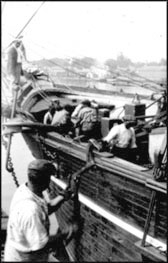
Seamen on the whaling bark Wanderer make ready to cast off for another voyage. The exact location is unknown, but probably New England.
Whaling: Opportunities for African Americans in a Hard Business
The whaling industry, centered until the 1870s in New Bedford, employed a large number of African Americans. This was in part due to the Quaker tradition of tolerance in the New Bedford area, but more importantly, to the large demand for manpower in an expanding industry requiring unusually large crews.
Some black seamen in the business were Americans, from the Northeast and the South, some were from the West Indies, and a significant group was from the Cape Verde Islands off the African coast. Whatever their origin, black seamen found acceptance as hard workers and skilled mariners in an industry that was physically demanding, dirty, and often financially unrewarding.
When the center of the industry moved to San Francisco in the 1870s, African Americans continued to form a large percentage of the crews. The whaling business was no doubt the largest employer of African Americans seamen on the West Coast until it ended shortly before World War I.
William T. Shorey (1859-1919) was a famous captain in the last days of whaling. He was born in Barbados, the son of a Scottish sugar planter and an Indian creole woman. Shorey began seafaring as a teenager and in 1876 he made his first whaling voyage.
Whaling brought him to California and he married the daughter from a leading African American family in San Francisco. In 1886 he became the only black West Coast ship captain. Known for his skill and leadership, Shorey experienced many adventures and dangers at sea with multiracial crews before his retirement in 1908.
Over time, larger, steam-powered vessels took the place of obsolete sailing ships and black seamen were forced to accept inferior employment on ships as cooks and stewards. The era of significant participation by blacks in whaling ended in 1923 when the Wanderer went aground off Nantucket, MA.
Black Men in Foreign Flag Sailing Ships
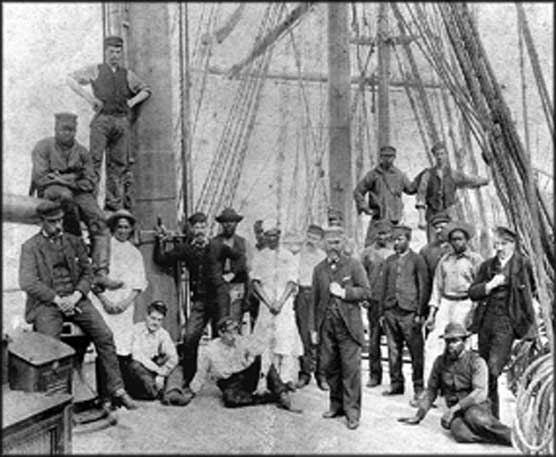
The crew of the British ship Rathdown,
photographed in San Francisco in 1892.
The two men in aprons are the cook and
steward but the other black men are all seamen.
Black men were often found among the crews of British ships, and even some German and Scandinavian ships, calling at West Coast ports. Black faces appear in about one quarter of all the foreign flag crew photographs in the park's collections. In many cases the men are clearly cooks or stewards, but in a surprising number of photos the men are obviously seamen, living and working on terms of complete equality with other members of the crew. The majority of black seamen in British ships were probably from the West Indies, but we do not have references for African Americans hired as seamen in foreign ships at New York and other East Coast ports.
The Navy: A Mixed Legacy
Throughout most of its history, the Navy has followed a policy of employing African Americans in all enlisted grades. They were active in both naval and privateer crews during the Revolutionary War. A brief period of discrimination ended with the War of 1812. From then until 1915 African Americans served in the ranks of all naval vessels. During the Civil War, at least six African Americans were awarded the Congressional Medal of Honor. Only officer ranks were closed to them during this period.
In 1915 an executive order from President Wilson ordered segregation for all branches in the military. Until 1942 African Americans were recruited only as messmen. During the rest of World War II, opportunities for African Americans gradually expanded and the first twelve officers were commissioned in 1944. In 1946 a Navy order finally ended official segregation throughout the Navy.
Desegregation in practice took somewhat longer to achieve, but was finally accomplished, and today the Navy can once again take pride in its tradition of racial equality.
Although the Navy had no commissioned officers in the 19th century, this restriction did not hold for the Revenue Service, the predecessor of the modern Coast Guard.
Captain Healy, an African American, rose to the rank of Captain in 1883. From 1886 until 1895 Healy commanded the Bear, a steam barkentine, on patrols in the North Pacific, Bering Sea, and Arctic Ocean. The Bear was virtually the only law in these Northern regions, enforcing quotas in the sealing industry, protecting native people from exploitation, and keeping the peace among white settlers. She performed many feats of heroic rescue among the whaling fleet and the isolated outposts of trappers and hunters.
Captain Healy was known as a stern disciplinarian, and was accused of brutalizing his seamen on at least one occasion. Although formally exonerated from these charges, it is no doubt true that he was a hard man, performing a difficult and demanding duty.
This information thanks to the National Parks Service (NPS)
Seamen on the whaling bark Wanderer make ready to cast off for another voyage. The exact location is unknown, but probably New England.
Whaling: Opportunities for African Americans in a Hard Business
The whaling industry, centered until the 1870s in New Bedford, employed a large number of African Americans. This was in part due to the Quaker tradition of tolerance in the New Bedford area, but more importantly, to the large demand for manpower in an expanding industry requiring unusually large crews.
Some black seamen in the business were Americans, from the Northeast and the South, some were from the West Indies, and a significant group was from the Cape Verde Islands off the African coast. Whatever their origin, black seamen found acceptance as hard workers and skilled mariners in an industry that was physically demanding, dirty, and often financially unrewarding.
When the center of the industry moved to San Francisco in the 1870s, African Americans continued to form a large percentage of the crews. The whaling business was no doubt the largest employer of African Americans seamen on the West Coast until it ended shortly before World War I.
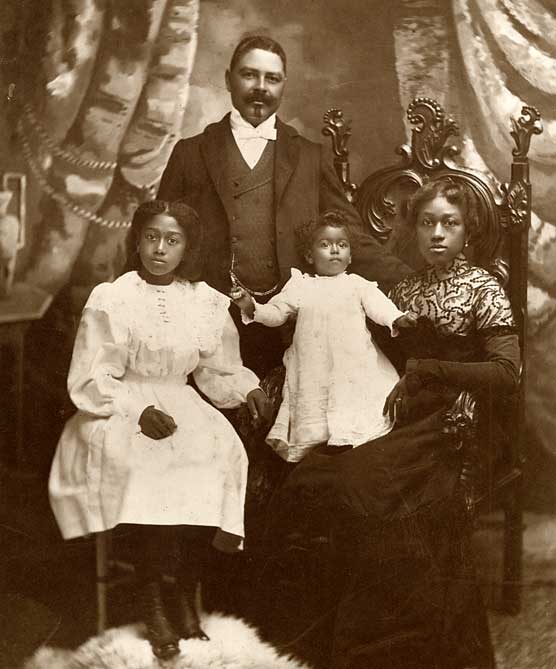
| NPS Captain William T. Shorey and family. |
William T. Shorey (1859-1919) was a famous captain in the last days of whaling. He was born in Barbados, the son of a Scottish sugar planter and an Indian creole woman. Shorey began seafaring as a teenager and in 1876 he made his first whaling voyage.
Whaling brought him to California and he married the daughter from a leading African American family in San Francisco. In 1886 he became the only black West Coast ship captain. Known for his skill and leadership, Shorey experienced many adventures and dangers at sea with multiracial crews before his retirement in 1908.
Over time, larger, steam-powered vessels took the place of obsolete sailing ships and black seamen were forced to accept inferior employment on ships as cooks and stewards. The era of significant participation by blacks in whaling ended in 1923 when the Wanderer went aground off Nantucket, MA.
Black Men in Foreign Flag Sailing Ships
The crew of the British ship Rathdown,
photographed in San Francisco in 1892.
The two men in aprons are the cook and
steward but the other black men are all seamen.
Black men were often found among the crews of British ships, and even some German and Scandinavian ships, calling at West Coast ports. Black faces appear in about one quarter of all the foreign flag crew photographs in the park's collections. In many cases the men are clearly cooks or stewards, but in a surprising number of photos the men are obviously seamen, living and working on terms of complete equality with other members of the crew. The majority of black seamen in British ships were probably from the West Indies, but we do not have references for African Americans hired as seamen in foreign ships at New York and other East Coast ports.
The Navy: A Mixed Legacy
Throughout most of its history, the Navy has followed a policy of employing African Americans in all enlisted grades. They were active in both naval and privateer crews during the Revolutionary War. A brief period of discrimination ended with the War of 1812. From then until 1915 African Americans served in the ranks of all naval vessels. During the Civil War, at least six African Americans were awarded the Congressional Medal of Honor. Only officer ranks were closed to them during this period.
In 1915 an executive order from President Wilson ordered segregation for all branches in the military. Until 1942 African Americans were recruited only as messmen. During the rest of World War II, opportunities for African Americans gradually expanded and the first twelve officers were commissioned in 1944. In 1946 a Navy order finally ended official segregation throughout the Navy.
Desegregation in practice took somewhat longer to achieve, but was finally accomplished, and today the Navy can once again take pride in its tradition of racial equality.
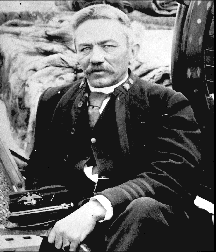
NPS Captain Michael Healy of the Revenue Cutter Bear. |
Captain Healy, an African American, rose to the rank of Captain in 1883. From 1886 until 1895 Healy commanded the Bear, a steam barkentine, on patrols in the North Pacific, Bering Sea, and Arctic Ocean. The Bear was virtually the only law in these Northern regions, enforcing quotas in the sealing industry, protecting native people from exploitation, and keeping the peace among white settlers. She performed many feats of heroic rescue among the whaling fleet and the isolated outposts of trappers and hunters.
Captain Healy was known as a stern disciplinarian, and was accused of brutalizing his seamen on at least one occasion. Although formally exonerated from these charges, it is no doubt true that he was a hard man, performing a difficult and demanding duty.
This information thanks to the National Parks Service (NPS)
Wednesday, February 9, 2011
Selma - Montgomery March 7, 1965 -
Selma to Montgomery
Demonstrators walk down a street during the civil rights march from Selma to Montgomery, Alabama in 1965.
(Peter Pettus. 1965. Library of Congress Prints and Photographs Division. Lot 13514, no. 25.
John Lewis (on right in trench coat) and Hosea Williams (on the left) lead marchers across the Edmund Pettus Bridge.
On Sunday March 7, 1965, about six hundred people began a fifty-four mile march from Selma, Alabama to the state capitol in Montgomery. They were demonstrating for African American voting rights and to commemorate the death of Jimmie Lee Jackson, shot three weeks earlier by an state trooper while trying to protect his mother at a civil rights demonstration. On the outskirts of Selma, after they crossed the Edmund Pettus Bridge, the marchers, in plain sight of photographers and journalists, were brutally assaulted by heavily armed state troopers and deputies.
One hundred years after the Civil War, in many parts of the nation, the 15th Amendment had been nullified by discriminatory laws, ordinances, intimidation, violence, and fear which kept a majority of African Americans from the polls. The situation was particularly egregious in the city of Selma, in Dallas County, Alabama, where African Americans made up more than half the population yet comprised only about 2 percent of the registered voters. As far back as 1896, when the U.S. House of Representatives adjudicated the contested results of a congressional election held in Dallas County, it was stated on the floor of Congress:
…I need only appeal to the memory of members who have served in this House for years and who have witnessed the contests that time and time again have come up from the black belt of Alabama—since 1880 there has not been an honest election in the county of Dallas…
Thursday, February 3, 2011
Black History Month - Where is the Change?
The Breaking of Fredrick Douglass
When Frederick was about sixteen, he was placed under the control of Edward Covey, a small farmer reputed to have the ability to break a slave’s spirit. Frederick was whipped repeatedly, and very nearly was “broken” in spirit until one day he fought back – defensively, not striking Covey, because that would likely have gotten him severely punished, possibly killed – but by simply fending off the farmer’s attack. The contest lasted about two hours, when Covey called it off, and he never attempted to beat Frederick again.
Jared Ball and Ishmael Reed (discuss) Reed's book
Obama, Jim Crow Media and the Return of the Ni**er Breakers (Click here to listen or download)
We can use more open discussions of this kind, since mass media does seem to have an agenda that doesn't include the improvement of our condition. While Mr. Reed and Mr. Ball are not always on the same page, in my opinion, they are both looking toward similar endings. Hopefully we will be able to get more input from the listening audience in discussions of this kind. Better yet, I hope this will stimulate more of us to participate in similar discussions of our own.
Monday, January 17, 2011
MLK's Letter from Birmingham Jail - "A Call for Unity" (1963)
This video is over an hour long but don't let that deter you from watching it. Please take the time to view this video. Take the time to share it with with our young people, who may not be aware of its contents or the valor of those who struggled during those trying times. The struggle is not over and they will need the examples of doctor King and those of us who worked with him to hold themselves and the country accountable for the injustices that are still occuring.
"Freedom must be demanded by the oppressed."
"Justice too long delayed is justice denyed"
"Freedom must be demanded by the oppressed."
"Justice too long delayed is justice denyed"
Thursday, February 11, 2010
The BlackPast.org website

If you want to stay at the head of the class for
Black History Month and the rest of the year,
Thousands of pages of Black History a mouse click away.
- African American History
- African American History in the West
- Global African History
Lots of photos but limited audio files thus far.
"BlackPast.org, an online reference center makes available a wealth of materials on African American history in one central location on the Internet. These materials include an online encyclopedia of over 1,500 entries, the complete transcript of over 125 speeches given between 1789 and 2008, over 100 full text primary documents, bibliographies, timelines and four gateway pages with links to 50 digital archive collections. Additionally 75 major African American museums and research centers and over 400 other website resources on black history are also linked to the website. The compilation and concentration of these diverse resources allows BlackPast.org to serve as the "Google" of African American history.""BlackPast.org (www.blackpast.org) began in January 2004 as an online reference center in African American history when Quintard Taylor, the Scott and Dorothy Bullitt Professor of American History at the University of Washington, and his graduate assistant, George Tamblyn, placed on his faculty website various reference materials which described historical figures and events discussed in Taylor’s class lectures. Soon afterwards they added a bibliography, a timeline, and links to other internet sites that presented or discussed various aspects of the black historical experience."
Wednesday, February 3, 2010
Who Killed Malcolm X?
Wow! Bev Smith conducts a compelling panel discussion on the subject of who was behind the assassination of Malcolm X. The participants are:
Manning Marable
Kalil Islam
George Curry
Abdul Alim Muhammad
H.S. Hamod
Les Payne
Who Killed Malcolm X? - A Panel Discussion Pt. 1
Who Killed Malcolm X? - A Panel Discussion Pt. 2
Who Killed Malcolm X? - A Panel Discussion Pt.3
Who Killed Malcolm X? - A Panel Discussion Pt.4
Who Killed Malcolm X? - A Panel Discussion Pt.5
Tuesday, February 17, 2009
The 16th Street Baptist Church bombing
The 16th Street Baptist Church bombing was a racially motivated terrorist attack on September 15, 1963, by members of a Ku Klux Klan group in Birmingham, Alabama in the United States. The bombing of the African-American church resulted in the deaths of four girls. Although city leaders had reached a settlement in May with demonstrators and started to integrate public places, not everyone agreed with ending segregation. Other acts of violence followed the settlement. The bombing increased support for people working for civil rights. It marked a turning point in the U.S. civil-rights movement of the mid-twentieth century and contributed to support for passage of civil rights legislation in 1964.
-from wikipedia
-from wikipedia
Friday, February 13, 2009
The US Government presents Black History Month 2012
Let's take a look at how our government
The theme for 2012
Black Women in American Culture and History
* Exhibits & Collections
* Images
* Audio/Video
* Profiles
* For Teachers
* Images Used On
This Site
is presenting BHM this year.
Black Women in American Culture and History
topics
* African American History Month Home
* About* Exhibits & Collections
* Images
* Audio/Video
* Profiles
* For Teachers
* Images Used On
This Site
Subscribe to:
Posts (Atom)