Newton Aduaka tells the story of Ezra | Video on TED.com
TED is a nonprofit devoted to Ideas Worth Spreading. It started out (in 1984) as a conference bringing together people from three worlds: Technology, Entertainment, Design. Since then its scope has become ever broader.
Showing posts with label Afrocentric history. Show all posts
Tuesday, September 6, 2011
Thursday, October 21, 2010
The Origin of Black History Month in the UK
Linda Bellos introduced Black History Month to the UK in 1987, she was born to a white Jewish British mother and Nigerian father and grew up in London.
As a child she heard white people tell her mother that she had betrayed ‘our boys’ by marrying a black man after the sacrifices White people had made in 2nd World War.
Linda later discovered that her father had volunteered for the Merchant Navy to help the mother country.
She also discovered that during the 2nd World War 2.5 million Indian/Pakistani/Sri Lankan/Bangladeshi men and women where involved in the War efforts and 1.5 million during the 1st World War.
Linda Bellos, Part 1 of 3, Black History Month Opening Address
As a child she heard white people tell her mother that she had betrayed ‘our boys’ by marrying a black man after the sacrifices White people had made in 2nd World War.
Linda later discovered that her father had volunteered for the Merchant Navy to help the mother country.
She also discovered that during the 2nd World War 2.5 million Indian/Pakistani/Sri Lankan/Bangladeshi men and women where involved in the War efforts and 1.5 million during the 1st World War.
Linda Bellos, Part 1 of 3, Black History Month Opening Address
Part 2 of 3
Part 3 of 3
Wednesday, July 14, 2010
Plenty of African American Charisma
I've been watching Charismaallover's Weblog
produced by Tamarva Butler over a period of about 24 months. I happened to see it on the Blogged web site today and was pleased to see that it has become even better than it was the last time I saw it. Ms Butler's education in Communication has not gone to waste. The young sister has put together an interesting, visually pleasing site that informs and entertains. This weblog is covering a variety of topics of interest to the African American viewer. I think it would be good for Black children also because Butler projects a very positive image as she touches historical and contemporary subjects. I cant' wait to see what she'll be producing when she turns pro. Check it out and see for yourself.
Thursday, May 6, 2010
Black Men in Navy Blue During the Civil War
Printed on: Thursday, May 6, 2010
Fall 2001, Vol. 33, No. 3
Black Men in Navy Blue During the Civil War
By Joseph P. Reidy
|
|
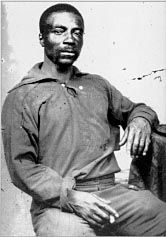
Civil War sailor George Commodore. (NARA, Records of the Veterans Administration, RG 15)
|
Given the wealth of available information about Civil War soldiers, the comparative poverty of such knowledge about Civil War sailors borders on the astonishing. Two explanations account for this imbalance. First, the broad narrative of presidential leadership and the clash of armies in Virginia that Ken Burns's The Civil War told so powerfully all but excludes naval forces from the tale. Second, existing accounts of the naval Civil War have focused on the strategic role of naval forces in the contest, the governmental architects of naval policy, the naval officers who masterminded operations, and the innovations in technology and weaponry to the near exclusion of the enlisted sailors' war. No image of "Jack Tar" comparable to Bell I. Wiley's classic portraits of "Billy Yank" and "Johnny Reb" fills the popular imagination or the works of Civil War historians.1
Because the navy, unlike the army, was racially integrated, understanding the history of black sailors requires some effort but even more interpretive caution to unravel it from that of all Civil War sailors. Exploring the similarities and differences in the experiences of black and white enlisted men must avoid viewing the racial groups in strictly monolithic terms that do not allow for internal complexity and diversity and shifting, if not altogether porous, borders. The work must also beware currently popular understandings of the black soldiers' experience. Often framed around the Fifty-fourth Massachusetts Volunteer Infantry, that tale depicts stoic sacrifice and daunting perseverance in pursuit of freedom and equality that in the end was crowned with "Glory," the impression conveyed by the popular feature film. The black sailors' story fits awkwardly, if at all, within that image.
The study of African Americans in the Civil War navy must begin with determining their numbers. During the first decade of the twentieth century, when the secretary of the navy was quizzed about the service of black men in the Civil War, senior officers who had served in the conflict recalled that approximately one-quarter of the enlisted force was black. In a grand display of false precision, the secretary's office concluded that 29,511 black men had served by taking the known figure of Civil War enlistments (118,044) and dividing by four.2 That figure remained essentially unchallenged until 1973, when David L. Valuska's dissertation revised it downward to slightly less than ten thousand men, based upon his survey of surviving enlistment records.3 Over the past decade, a research partnership among Howard University, the Department of the Navy, and the National Park Service has made possible an examination of a fuller array of records than earlier researchers, working as individuals, were able to explore.4 As a result, nearly eighteen thousand men of African descent (and eleven women) who served in the U.S. Navy during the Civil War have been identified by name.5 At 20 percent of the navy's total enlisted force, black sailors constituted a significant segment of naval manpower and nearly double the proportion of black soldiers who served in the U.S. Army during the Civil War.6
At the start of the conflict, the army and the navy drew upon separate traditions regarding the service of persons of African descent. Following adoption of the federal Militia Act in 1792, the army excluded black men, and the prohibition remained in effect until the second summer of the Civil War. The navy, in contrast, never barred black men from serving, although from the 1840s onward regulations limited their numbers to 5 percent of the enlisted force. When the war began, several hundred black men were in the naval service, a small fraction of those with prewar experience and a figure well below the prescribed maximum. During the first ninety days after Fort Sumter, when nearly three hundred black recruits enlisted, fifty-nine (20 percent) were veterans with an average of five years of prior naval service per man.7 Over succeeding months, the proportion of black men in the service increased rapidly. At the end of 1861, they made up roughly 6 percent of the crews of vessels. By the summer of 1862, the figure had climbed to nearly 15 percent.8
At first, navy officials did not treat black manpower separately from their general need for men as the service expanded and as volunteer army units competed for the able-bodied. With enlistment centers at the major Atlantic ports from Chesapeake Bay through New England, recruiters could draw upon the international seafaring fraternity to supplement the recruits from the seaboard states. By the end of the war, some 7,700 of the roughly 17,000 men whose place of nativity is recorded had been born in states that remained within the Union. Not surprisingly, the coastal states contributed the largest numbers of men: New York and Pennsylvania roughly 1,200 each, and Massachusetts and New Jersey more than 400 each. Many of these men had been mariners before the war, and still others had worked on the docks and shipping-related businesses of the seaport cities. Additional recruits with prior maritime experience on the lakes and rivers of the nation's interior also enlisted; these included 420 natives of Kentucky. The largest number of black men from any of the northern states— more than 2,300 in all— hailed from Maryland. The maritime culture of Chesapeake Bay, with its numerous tributaries and the port of Baltimore, offer part of the explanation for the large number of Marylanders in naval service. The size of the Maryland contingent also benefited from a spring 1864 agreement between army and navy officials to transfer nearly eight hundred black Marylanders from incomplete units of the U.S. Colored Troops into the navy.9
Another fifteen hundred men were born outside of the United States, chiefly Canada and the islands of the Caribbean.10 Like their counterparts from the United States, the foreign-born men entered service for a variety of reasons. John Robert Bond, for instance, a mariner of mixed African and Irish descent from Liverpool, England, enlisted during 1863 "to help free the slaves," as his descendants recall. Seriously wounded the following year, he was discharged and pensioned after a long recuperation. He settled in Hyde Park, Massachusetts, amid other black Civil War veterans.11
The remainder of the 17,000 men whose place of nativity is recorded— some 7,800 in all— were born in the seceded Confederate states. The firsthand experience that these men had with slavery distinguished them from their freeborn northern counterparts. Moreover, whereas northern freemen could enlist when they chose, men held in bondage often had to rely on the circumstances of war for the opportunity to do so. Not simply awaiting their fate, black men escaping from slavery helped create opportunities for the federal government to protect them and accept their offers of service. By September 1861, the volume of requests from commanders of naval vessels regarding authorization to enlist fugitive slaves reached such proportions that Secretary of the Navy Gideon Welles, a Connecticut native of antislavery bent, felt obliged to act. Welles permitted the enlistment of former slaves whose "services can be useful," stipulating that the "contrabands" be classified as "Boys," the lowest rung on the rating and pay scales and one traditionally reserved for young men under the age of eighteen.12 (The term "contraband" itself had within weeks of Fort Sumter sprung into widespread use throughout the North as a rationale for treating such persons as plunder under international conventions of warfare.) The practical effect of this policy became evident when Flag Officer Samuel F. Du Pont established federal control of the harbor at Port Royal, South Carolina, in November 1861. This beachhead eventually became the home port of the South Atlantic Blockading Squadron, with repair and supply facilities that employed nearly a thousand contrabands. At the same time, vessels in all the squadrons began taking fugitive slaves on board, enlisting the men as needed and forwarding others to places of safety.13
The large concentrations of enslaved African Americans on the plantations along the Mississippi River and the strategic importance of the river to both sides assured that Secretary Welles's directive regarding the employment of contrabands would have special relevance to the Mississippi Squadron. In April 1863, as the combined army and navy assault on Vicksburg, Mississippi, took shape, Flag Officer David D. Porter instructed the commanders of vessels to take full advantage of "acclimated" black manpower.14 Under these guidelines, more than two thousand men enlisted on the vessels that plied the Mississippi and its tributaries.15 The refugee camps that sprang up in Union-occupied areas also proved a rich source of recruits. In the camps of coastal North Carolina, for instance, recruiters from the North Atlantic Blockading Squadron displayed posters promising good pay and other amenities and urging volunteers to "Come forward and serve your Country."16
The success of these efforts to recruit black men from the Union-occupied regions of the South tipped the demographic balance among black sailors. Largely free men with considerable naval experience at the start of the war, over time the force included growing numbers of recently enslaved men with only limited maritime experience. Not surprisingly, most were from the states where Union naval forces operated: the Carolinas, Mississippi, and Louisiana. The largest contingent of southern-born men, however, was the Virginians, more than twenty-eight hundred strong, numbers of whom had been sold before the war from their native state to plantation regions farther south. The fact that nearly six thousand (roughly 35 percent) of the black sailors whose nativity is known came from the Chesapeake Bay region is striking. Even more so is that more than eleven thousand men were born in the slave states as against four thousand born in the free states. Even allowing for the fact that a small fraction of those from the slave states had been born free, nearly three men born into slavery served for every man born free. Hardly predictable from the record of black sailors in the antebellum navy, this demographic division profoundly influenced the black naval experience during the war.
Quarterly muster rolls of vessels clearly demonstrate the navy's reliance on black manpower between 1862 and 1864, as the following table indicates.17
Table 1: Aggregate Percentages of Black Enlisted Men Serving on Board U.S. Naval Vessels by Quarter of the Calendar Year, 1862 - 1865
| |
Quarter
|
Percentage
|
1st Quarter 1862
|
8
|
2nd Quarter 1862 through 2nd Quarter 1863
|
15
|
3rd Quarter 1863 through 3rd Quarter 1864
|
23
|
4th Quarter 1864 through 3rd Quarter 1865
|
17
|
4th Quarter 1865
|
15
|
Source: Muster Rolls of Vessels, Records of the Bureau of Naval Personnel, Record Group (RG) 24, National Archives.
| |
From the spring of 1861 through the fall of 1864, the percentage of black men increased steadily from a starting point of less than 5 percent to a peak of 23 percent. In this context, the Navy Department's rule-of-thumb estimate from early in the twentieth century that one quarter of the enlisted force was black comes very close to describing the reality from summer 1863 through summer 1864. By the fall of 1865, after most wartime volunteers had been discharged, black men still constituted 15 percent of the enlisted force, more than three times the percentage of black men in service at the start of the war.
The racial demographics of the enlisted force varied— often significantly— by squadron and by vessel. In the European Squadron, for instance, a handful of ships cruising the North Atlantic in pursuit of Confederate commerce raiders and blockade runners, the number of black sailors was small. Given that most of the ships were outfitted and manned early in the war, the demographic profile of Kearsarge, perhaps the most famous of the bunch, wherein black men made up 5 to 10 percent of the crew, was entirely typical. In the North Atlantic Blockading Squadron, which drew men from the traditional enlistment points along the northeast Atlantic seaboard as well as from the coastal regions of Virginia and North Carolina, the proportion of black enlisted men was considerably higher than that of the European Squadron. The Mississippi Squadron, which drew recruits from Cincinnati, Ohio, and Cairo, Illinois, as well as from its areas of operations along the Mississippi River and its tributaries, relied most on black manpower. In David Farragut's West Gulf Blockading Squadron, the proportion of black sailors fell well short of that in the Mississippi Squadron or the North Atlantic Blockading Squadron.
Table 2: Percentages of Black Enlisted Men Serving on Board U.S Naval Vessels in Three Representative Squadrons, Second Quarter of 1864
| ||
Squadron
|
Percentage
| |
North Atlantic
|
25
| |
West Gulf
|
20
| |
Mississippi
|
34
| |
Source: Muster Rolls of Vessels, RG 24, National Archives.
| ||
At the level of individual vessels, the racial demographics of crews reflected a more complex array of variables, including the type of vessel, its tactical mission within a larger unit of operations, and the personality of the captain, his officers, and the ship's company. The broader cultural biases that associated persons of African descent with menial labor and personal service also influenced these demographic patterns. The disproportionate presence of black sailors on supply ships illustrates this point. During 1863 and 1864, virtually every man attached to USS Vermont, moored at Port Royal and serving as the supply ship for the South Atlantic Blockading Squadron, was black.18 At Hampton Roads, where another vintage ship-of-the-line, USS Brandywine, stored supplies for the North Atlantic Blockading Squadron, the proportion of black enlisted men ranged between 47 and 57 percent during 1863 and 1864.19
In analogous fashion, black men filled an inordinately large number of the enlisted billets on the barks and schooners that served as colliers and ordnance storeships. Between 67 and 100 percent of the enlisted men serving in Charles Phelps, Fearnot, J. C. Kuhn, Albemarle, Arletta, and Ben Morgan were black.20 In the supply steamers New National (Mississippi Squadron), William Badger (North Atlantic Blockading Squadron), and Donegal (South Atlantic Blockading Squadron), the proportion of black enlisted men ranged from 63 to 100 percent.21 Conversely, black men made up the smallest proportion of men in the sloops of war and other ocean-going warships that were the backbone of the late antebellum navy and the workhorses of the blockading squadrons.
The black enlistees who had been slaves— in many instances down to the time of enlistment— stood apart from the freemen of all colors and nations. Often accepted into service on a supposition of inferiority, stigmatized as "contrabands," and rated and paid at the lowest levels of the rating and pay scales, these men often could not escape the stereotypes cast upon them no matter how creditably they performed their assigned duties. In, but not necessarily of, the crews with which they served, the contrabands performed the manual labor necessary to keep a steam vessel functioning and the busywork that officers considered the foundation of good order and discipline on warships: holystoning, scrubbing, scraping, painting, and polishing. Although black men routinely served on gun crews at general quarters, they stood a far greater chance of serving with small-arms crews, armed with swords, rifles, and pistols, for repelling boarders, and with damage control units, armed with water hoses for dousing fires and battle-axes for cutting away damaged spars and rigging. Small-arms crews consisting of contrabands generally exercised separately from those consisting of white sailors.22
USS Miami (Courtesy, Naval Historical Center)
|
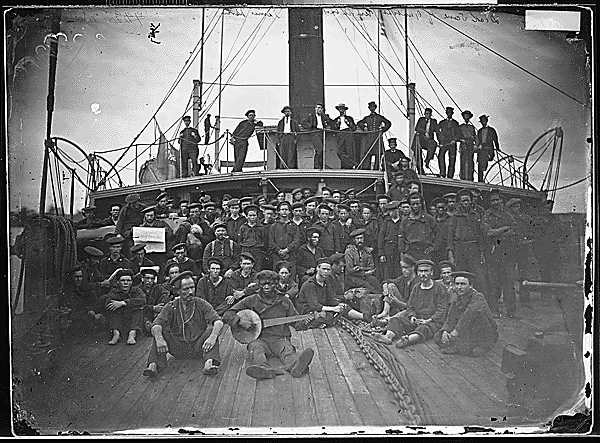
USS Hunchback (NARA, NWDNS-111-B-2011)
|
Given the pervasive prejudice among white officers and enlisted men, black men sought out their own company as much as possible. Such a pattern of association derived largely from the rating structure, but enlistment patterns and prewar associations also played a part. A surviving photograph of USS Miami illustrates. Around the time of the photograph, about one-quarter of the approximately one hundred enlisted men were of African descent, nearly all contrabands rated as boys and recently enlisted at Plymouth, North Carolina; a number shared the surnames of Etheridge, Johnson, White, and Wilson.23 In a similar photograph of Hunchback, the cluster of black men to the right invites similar scrutiny. During the middle of 1864, approximately twenty-five of the roughly one hundred enlisted men were of African descent. Fifteen of the men were contrabands from Maryland who had recently been transferred from the army to the navy.24
Joseph P. Reidy has taught U.S. history at Howard University since 1984 and for the past three years has also served as the Associate Dean of the Graduate School. He has published widely on slavery, the Civil War, and slave emancipation in both scholarly and popular journals. At present he directs the African-American Sailors Project at Howard University, from which work the present article derives.
Articles published in Prologue do not necessarily represent the views of NARA or of any other agency of the United States Government.
|
The U.S. National Archives and Records Administration
8601 Adelphi Road, College Park, MD 20740-6001 •
Telephone: 1-86-NARA-NARA or 1-866-272-6272
Also see Turn of the century black sailors.
Also see African American Crew on WWII Destroyer Escort.
Telephone: 1-86-NARA-NARA or 1-866-272-6272
Also see Turn of the century black sailors.
Also see African American Crew on WWII Destroyer Escort.
Monday, February 1, 2010
‘Haiti did not fail,’ ‘it was destroyed’
The following quote by Napolean speaks volumes.
“My decision to destroy the authority of the blacks in Saint Domingue (Haiti) is not so much based on considerations of commerce and money, as on the need to block for ever the march of the blacks in the world.”
- Napolean Bonaparte
Pambazuka News feature
The hate and the quake
Hilary Beckles
2010-01-28, Issue 467
‘Haiti did not fail,’ writes Hilary Beckles, ‘it was destroyed by two of the most powerful nations on earth, both of which continue to have a primary interest in its current condition.' Buried 'beneath the rubble of imperial propaganda', says Beckle, is 'the evidence which shows that Haiti's independence was defeated by an aggressive North-Atlantic alliance that could not imagine their world inhabited by a free regime of Africans as representatives of the newly emerging democracy.’
The University of the West Indies is in the process of conceiving how best to deliver a major conference on the theme ‘Rethinking and rebuilding Haiti’.
I am very keen to provide an input into this exercise because for too long there has been a popular perception that somehow the Haitian nation-building project, launched on 1 January 1804, has failed on account of mismanagement, ineptitude, corruption.
Buried beneath the rubble of imperial propaganda, out of both Western Europe and the United States, is the evidence which shows that Haiti's independence was defeated by an aggressive North-Atlantic alliance that could not imagine their world inhabited by a free regime of Africans as representatives of the newly emerging democracy.
The evidence is striking, especially in the context of France.
The Haitians fought for their freedom and won, as did the Americans fifty years earlier. The Americans declared their independence and crafted an extraordinary constitution that set out a clear message about the value of humanity and the right to freedom, justice, and liberty.
In the midst of this brilliant discourse, they chose to retain slavery as the basis of the new nation state. The founding fathers therefore could not see beyond race, as the free state was built on a slavery foundation.
Monday, January 11, 2010
Speak It! From the Heart of Black Nova Scotia 1992
by Sylvia Hamilton
"One of the best things about learning, is passing on what you discover to other people." Shingai Nyajeka."
A film about a group of Black Nova Scotian students and their quest for knowledge of self and their place in their own and the community at large.
In the face of racism and marginalization, they work to establish a Cultural Awareness Youth Group, a vehicle for building pride and self-esteem through educational and cultural programs. With help from mentors, they discover and share, the richness of their heritage and learn some of the ways they can begin to affect change. Shot on location in Halifax, Nova Scotia (Canada)
"Nova Scotia in black context:
People of African descent have been living in Nova Scotia for almost 300 years. In Acadia, from the early to mid 1700s, there were more than 300 people of African descent in the French settlement at Louisbourg, Cape Breton.
In Halifax in 1751 there were 15 Black people. Between 100 and 150 people of African descent were among the new settlers, now known as the Planters, who came from New England after the British gained control over Nova Scotia in 1763.
Over 3,000 Black people came as part of the Loyalist migration between 1783 and 1785.
In 1796, 550 people, known as the Maroons, were deported from Jamaica to Nova Scotia. In 1800 they were relocated to Sierra Leone.
Some 2000 escaped slaves came from the United States during the War of 1812, under conditions similar to those of the Black Loyalists. They had thrown in their lot with the British between 1812 and 1816 and were offered freedom and land in Nova Scotia. They moved into the Halifax area to settle at Preston, Hammonds Plains, Beechville, Porter's Lake, and the Lucasville Road, as well as the Windsor area.
In the early 1900s Black immigrants were actively recruited from Barbados, West Indies to work in Cape Breton for the Dominion Coal Company. This community survives to the present day in Whitney Pier, Glace Bay and New Waterford.
People of African descent continue to immigrate to Nova Scotia today."
Tuesday, January 5, 2010
Afrocentric history. Drusilla Dunjee Houston
BIOGRAPHY: Drusilla Dunjee Houston (1876-1941)
In 1999, the Uncrowned Queens Institute for Research and Education on Women, Inc. was established in Buffalo, New York in honor of Drusilla Dunjee Houston. The Institute is named after Houston’s 1917 poem entitled America’s Uncrowned Queens. Like many African American women writers swallowed up and languishing in the historical gap, Houston is one of the most prolific and all but forgotten African American women writers of the 20th century. Considered a “historian without portfolio” and dismissed as a serious historian and writer by leading Black male historians of Post Emancipation and the Harlem Renaissance, e.g., W.E.B. DuBois, Alaine Locke, Carter G. Woodson and others, Houston burst on the historical literary scene in 1926 with Volume I of her magnum opus Wonderful Ethiopians of the Ancient Cushite Empire Book 1: Nations of the Cushite Empire, Marvelous Facts from Authentic Records thought to represent the crowning achievement of Drusilla Dunjee Houston’s literary life. Houston is remembered as the earliest known and possibly the only African American woman to write a multi-volume study of ancient Africa where she unapologetically proclaimed in 1926, an African origin of civilization and culture during one of the most turbulent periods for black Americans in American history.
Wonderful Ethiopians
of the
Ancient Cushite Empire
by Drusilla Dunjee Houston
PREFACE.
THE ORIGIN OF CIVILIZATION.
The minds of men today are stirred with eager questionings about the origin of civilization and about the part the different races of mankind played in its development from primitive. ages. The remains that archaeologists are uncovering in Egypt, old Babylonia, and South America, reveal that there were significant factors in the first development of the arts and sciences that history has failed to make clear. Scientists are busy today studying the types of those old civilizations and comparing them with those of the present. Our modern systems do not function for the masses to give them development and happiness as did some of the ancient cultures. Books upon the early life of man are very hard to secure. Few have been written that are authentic, because it requires technical skill to assemble and condense such matter. Exhaustive research work is necessary to secure this kind of information, with only a line here and there in modern books to help the reader to reach definite conclusions. Only the trained mind holds the multitude of details and possesses the ability to impartially weigh and classify the facts, that prove the influence of the races upon the civilization of today.
The quest for the innumerable and startling facts of the succeeding volumes arose, much as
p. 2
did the motive of Schliemann to seek the buried ruins of Troy, from the oft repeated expression found by the author in research work, that "what the ancients said about the Ethiopians was fabulous." Curiosity was aroused to go back over the story of the ancients to agree or draw new conclusions. The finds were so astonishing that the vow was made to spend upon this study many years if necessary. Like the "Quest of the Holy Grail" the aim became sacred, for the trail led backward into the heart of all that the world holds most precious and to the primal roots from which all culture sprang. At first the reading of an afternoon in the average public library would hardly reveal a line to the credit of the Ethiopian. Sometimes a ten volume set of modern books might yield only a few paragraphs; but the vow and the richness of the finds, gleaming like diamonds, led the eager searcher on. The trail was followed into the dry dusty books of the ancients, where the path widened and truth was revealed that will answer some of the baffling problems of civilization today. Here were missing links of the chain of culture vainly sought for elsewhere.
Our story will deal with the ancient Cushite empire of Ethiopians, that covered three continents and held unbroken sway for three thousand years. We will visit old Ethiopia, where as Herodotus said, "the gods delighted to banquet with the pious inhabitants." We will study the land and the ancient race. The "Old Race," will next win our attention, that Petrie found in Egypt of distinct and unique culture, who were the people
of the earlier and superior civilization of the first dynasties. Down through this prehistoric vista we see "Happy Araby" with her brilliant primitive culture and her unrivalled literature of later days. On the screen flashes the rich and surpassing culture of old Chaldea, which belonged to the ancient Cushite empire of Ethiopians. Next comes veiled and mysterious India, the scene of charming story and magic fable, with her subtle mysticism and philosophy. Tarrying a while with the conquest and life of the ancient Medes and Persians, the trail runs far afield into the dominions of Western Europe and the striking questions array themselves demanding to be answered. Who were the Celts? Who were the Teutons? and what was the origin of the so-called Aryan race? The author was as much astounded as will be the reader, as to what this study reveals. It leaves us wondering if there is any Aryan race.
We learn in the study of the races of Western Europe, to understand the hatreds of Europe that underlaid the world war. We learn that when the Celt and Teuton call the Ethiopians of the new world "Uncle" and "Auntie," they are using titles that are scientifically true. Our story passes on to another remnant of the ancient Cushite empire, that baffling race, the Iberians, now represented by the Basques; then to the Berbers of North Africa,. another branch of the Cushite race. Some scientists have called them the descendents of the "People of Atlantis." Next succeed the singular facts about the life of the mysterious Etruscans of old Italy who were the
p. 4
teachers of the Romans; then we follow the life and tragedy of the fleeting Pelasgians, who were the fountain out of which later Greek culture welled. They were the people of the legends of Greek mythology. It is almost impossible to find anything but scanty fragments in the world's literature about any of these people of pre-historic days, but our text has compiled these fragments, so many of them, as to form fascinating chapters. Today all of these subjects remain unexplained mysteries in the average book. We dwell for a while on the marvels of the lost civilization of the Ægean and stop to study the Greece of Homer and the meaning of the Greek legends. All having direct relation to the ancient Cushites.
Historic Greece in all her glory, but viewed from new angles, passes before us with the older and superior civilization of Asia Minor, which has been almost entirely overlooked in modern literature. Next we come to the fact that the Phoenicians called themselves Ethiopians and that the Hebrew writers gave them the same name; then we reflect upon the strange relationship of the family of Cushite tongues to the so-called Indo-European group of languages. The trail leads us high up to where we get a breathless view of the astounding Ethiopian religion, which gives us the answer to many strange and incomprehensible traits in the Ethiopian of today. Next follows the chapter on the "Wonderful Ethiopians," who produced fadeless colors that have held their hues for thousands of years, who drilled through solid rock and were masters
p. 5
of many other lost arts and who many scientists believe must have understood electricity, who made metal figures that could move and speak and may have invented flying machines, for the "flying horse Pegasus" and the "ram of the golden fleece" may not have been mere fairy tales. Next out of the forgotten wastes of the dark continent rise before us ancient African empires, representing other civilizations of the time of the Cretan age. Then across the screen comes flashing the "Ancient Cushite Trade Routes," which contrary to our notion were the medium by which rich and varied products were interchanged.
In the chapter on "Ancient Cushite Commerce," we follow the ships of these early, daring and skillful seamen, who before the dawn of history had blazed out the ocean trails that the Phoenicians later followed. We find irrefutable evidence of the presence of these daring conquerors in the primitive legends, religion and institutions of America. Next out of the dim haze of far antiquity, rise the indistinct lines of "Atlantis of Old," the race that gave civilization to the world, the race that tamed the animals and gave us domestication of plants. The gods of the ancient world were the kings and queens of mystic "Atlantis." The chapter the "Gods of Old" makes plain that the deities of Greece and Rome were also the kings and queens of the ancient Cushite empire of the Ethiopians, which was either the successor of the most famous branch of the Atlantic race. It was about these princes
p. 6
and heroes that all the wonderful mythology of the ancients was woven. They were the deities that were worshipped in India, Chaldea, Egypt, and in Greece and Rome, which nations themselves must have been related to the race of Atlantis, that tradition said had been overwhelmed by the sea. Atlantis could not have been mythical, for her rulers were the subjects of the art and literature of all the primitive nations until the fall of Paganism long after the birth of Christ.
Another division of Atlantis was trans-Atlantic America. There the mysterious Mound Builders represent the ancient Cushite race. We study the peculiar culture and genius of the fierce Aztec, who acknowledged that he received the germs of civilization from the earlier Cushite inhabitants. We pass southward and examine the higher development of the wonderful Mayas of North America, whose ruins are attracting special study today and we find there transplanted the Cushite arts of the ancient world. Next flash the pictures of the marvelous culture and arts of the Incas, superior to those of Western Europe in 1492. From America the story turns to the "Bronze and Iron Ages," we seek the origin of the mysterious bronze implements of Western Europe found in the hands of seemingly barbarous people. We seek for the place and the race that could have given the world the art of welding iron. The trail reveals that the land of the "Golden Fleece" and the garden of the "Golden Apples of Hesperides" were but centers of the ancient race, that as Cushite Ethiopians
p. 7
had extended themselves over the world. These are subjects that have attracted the study of world scholarship. They represent not mere myths but are all that vast ages have left to us of events of primitive race history. "Cushite Art" and "The Heart of the African" answer many questionings of our hearts about Ethiopians. The series closes with a comparison of ancient culture with modern forms. The intelligence of the Cushite, his original genius is held up beside the decadence of true ideals in the art and literature of the present. The "Revolt of Civilization" and "Dawn of a new World" voice the concern of the thoughtful over the present decay of culture.
We are sending forth this information because so few men today understand the primitive forces that are the root of modern culture. So superficial and prejudiced has been most modern research, that many important and accepted theories of universal history have no actual basis in fact. The average modern historical book contradicts what the ancients said about the nations. that preceeded them. We cannot solve the stupendous problems that the world faces, until we can read aright the riddle of the evolution of the races. Uninformed men make unsafe leaders. that is the primal cause for so many errors of judgment in state and national councils. We look upon them not as statesmen but as promoters of petty politics, for out of their deliberations spring no alleviation of the woes of the world. It is from this lack of understanding in leadership
p. 8
that the world suffers most today. We could discriminate between the true and false in our civilization, if we knew more about primitive culture. The way by which the first man climbed must ever be the human way. Racial prejudices are the greatest menace to world progress. Classes clash because the wealth of the world concentrates more and more in the hands of a few. The tragedy of human misery increases, the increase of defectives, the growing artificiality of modern living, compels us to seek and blazen forth the knowledge of the true origin of culture and the fundamental principles that through the ages have been the basis of true progress. Only by this wisdom shall we know how to lift human life today.
In most modern books there seems to be preconcerted understanding to calumniate and disgust the world with abominable pictures of the ruined Ethiopian, ruined by the African slave trade. of four hundred years. There seems to be a world wide conspiracy in literature to conceal the facts that this book unfolds. Because of this suppression of truth, world crimes have been easily made possible against the Ethiopian. These people are held in low estimation because truth is hidden which proves that today though more favored races are at the apex of human accomplishment; yet in the earlier ages the wheel of destiny carried upward those, who now seem hopelessly under. To wipe away the black stain of the slave trade, modern literature has represented the slave trader as having trafficked in depraved human beings. Today the lower types of
p. 9
the Aryan race look upon them as creatures only fit for political and economic spoilation, to fill the coffers of the colonial renegade, who could not succeed at home. This type of the world finds it easy to stifle the life of ruined and defenceless races. This spoilation of the weak, returned in a counter stroke from which it was impossible to escape in the world war. Belgium reaped in identical measure and kind, what this type had meted out to the defenceless people of the Congo. Nations must reap what they sow.
This is not the nature or intention of the better men of the civilized nations but we are uninformed about alien peoples. We are narrow and provincial in our views. The hatred of the races springs out of misunderstanding. The men of the world who have traveled, and read, and thought, upon ethnological problems are the men who have the cultivated instincts of human brotherhood. Shall England, France, Germany, America, suffer further because we have not taught the uninformed of the nations that we must pay a still heavier toll for a continued measure of injustice to weaker peoples? Innocent must suffer with the guilty, for it is in our power to inform and curb the power of the selfish. The question looms large in the minds of thinking men today, whether Ethiopians are worthy of equal opportunity. Let us settle forever out of time's irrefutable evidence, whether if we gave him the chance, the Ethiopian would treat us as we have treated him. There need be no conjecturing; for the archives of the past hold the facts. The history of the
p. 10
[paragraph continues] Cushite Ethiopians down through the ages is one of the most thrilling as well as tragic of all time's age old stories. It is almost incredible that its rich treasure for developing our understanding has so long remained veiled.
The Ethiopian is a great race, probably the oldest. It is a race that does not die out under adversity. When other races are sullen, or despairing and turn to self destruction, these people cheerfully press on. When they think the way is blocked they turn aside to pick flowers along the pathway of pleasure. We hear their happy voices in the cotton field, they can be the life of the carnival, their zealous fervor in camp meeting and the swing song of the marching black regiments of the world war and the stevedore regiments in peace, show these people as they employ themselves, patiently waiting for bars to progress to rot down, if nothing else will remove them. Then again they take up the steady march onward, that has been the wonderful element of their history on down through the ages. We need our eyes opened, this type that we in ignorance despise, built the eternal pyramids of Egypt and laid the foundation of the civilization of the historic ages, Because the slave trade broke the threads of remembrance, they walk among us with bowed heads, themselves ignorant of the facts that this story unfolds.
Lift up your heads, discouraged and downtrodden Ethiopians. Listen to this marvelous story told of your ancestors, who wrought mightily for mankind and built the foundations of civilization
p. 11
true and square in the days of old. Awake ye sleeping Aryans, become aware of the acute need of the world today of this enchained energy and ability. The absence of this power is the cause of many a breakdown in modern, civilization. Out of our own accepted sciences, the chapters of this book, prove the Cushite race to have been the fountainhead of civilization. If you desire truth, if you desire to be fair minded, to be educated in vital knowledge not possessed by the average college student, if you desire to be an authority upon the life of the ancients, go down with me as archaeology, ethnology, geology and philology disclose; not in a dry and tedious way, but through the unfolding of this the most intensely interesting and startling drama of the ages. The Cushite race, its institutions, customs, laws and ideals were the foundation upon which our modern culture was laid. Let this not stir the pride of the modern Cushite, but rather inspire him to a greater consecration to the high idealism that made the masteries of olden days.
Knowledge of the primal strength and weaknesses of each world group must be possessed by world leadership or we shall still further go astray. Without this knowledge international councils cannot intelligently assign each race to its rightful place in the consummation of God's plan of the Ages. Without this truth the nations cannot put over their programs. The world war proved that we have no international stability. The world's securities and diplomatic relations are propped. Because the real history of mankind
p. 12
is not a part of our general knowledge, we are discounting factors most needed to secure world balance. There can be no more needed contribution to civilization, than to gather from the archives of the past and present day science all the truth about the origin of culture. Only thus will we know how to develop better men today. If we knew just what contribution each race has made to art, science and religion, we would know what would be its fitness to take part in world government and control. Hag the influence of a race been creative or destructive throughout the ages? That should point plainly to the part they would be likely to play today.
Because we are without this knowledge, we cannot read aright the past or present history of civilization. Modern crimes of injustice toward weaker peoples have been made easy by this suppression of truth. It has been popular and remunerative to write and speak on the side of prejudice. A better spirit is rising in the world. Men are eager for information, for the truth. Through the teaching of sociology, the most popular and crowded classes of our great universities, in a scientific way, man is beginning to see the need of a realization of our common brotherhood and to reach out to solve unmastered problems and unfulfilled duties. Many problems are an international consternation because they are too gigantic for the handling of any one world group. Civilization was appalled at its helplessness in the world war. The leading nations faced annihilation, yet were unable to walk out of the trap
p. 13
until the flower of European manhood had perished. The noblest offered themselves for sacrifice, the more selfish remained at home. The world may never be capable of calculating its artistic and moral loss. We see the difference in the crime and debauchery breaking down the culture of today. Unless we can rouse men to truth and united effort, there is no hope for our civilization which is tottering and must fall.
In justice to that Divine Leading that piloted this search of a decade over trails, that otherwise might not have been found in a lifetime, in tribute to the pluck and consecration to a purpose--to add to the light of truth, that has gathered such an avalanche of testimony from authoritative sources, we speak of this work which has taken all those spare moments, that are our right to spend in leisure, that a frail unflagging spirit might make possible this marvelous story, as strange as any olden fairy tale; yet by the light of our accepted sciences true. We lift the veil lightly lest the careless skim over these pages carelessly, little recking what they have cost. Often when limbs and weary brain cried out in protest, the searcher pressed on, seeing fully the power in this truth if patiently, carefully gathered, to lift the men of all races to a clearer comprehension of the contribution of each race to all that we prize in civilization, and to stir within us the determination to lift and bear aloft the "torch" lit in primitive ages by a race today despised and misunderstood. The average book has its dozen helpers and advisors, this work has
p. 14
been done in hermitage. The hermitage of a life submerged in service. Humbly, reverently, this truth is offered in love to all races. Ten years more may be devoted to its final setting but the facts imbedded in these pages are too important to be longer withheld.
This work is in the public domain click here for the complete volume.
Subscribe to:
Comments (Atom)