Michael Franti
Friday, December 10, 2010


Saturday, November 27, 2010
Black Mother Black Daughter - Nova Scotia Women of Color
Black Mother Black Daughter
Rose Fortune was almost certainly the daughter of "Fortune — a free Negro", who came to Nova Scotia after the American War of Independence. He appears with his wife and a "child above ten" (probably Rose) in the muster roll of Loyalists at Annapolis in June 1784.
Rose earned her living as a trucker at Annapolis Royal. She carried baggage by a heavy wheelbarrow for the many passengers who travelled on the Saint John-Digby-Annapolis ferry. She also on occasion provided other assistance to travellers, such as helping them find better accommodation. Rose had two daughters and two grandsons. Family tradition states that one of her customers was Judge Haliburton, who came to Annapolis Royal to conduct court for the day. He relied on Rose to waken him the next morning and get him on board ship so that he would be in Digby in time to hold court there. (Noted author T.C. Haliburton was a judge of the Supreme Court, 1841-1856.)
Along with the carting and wake up services, Fortune established curfews and standards of behavior on the wharf. Her words of enforcement established her as the first police woman in Canada. She told stragglers to move along and to clear the streets before she turned in.
Although suffering from severe rheumatism in her later years, Rose continued to work until well into her seventies.
Black Mother Black Daughter
An NFB film by Claire Prieto & Sylvia Hamilton,
This is a wonderful film that chronicles the lives of Black Nova Scotian Women and their contributions to their communities socially, economically and spiritually as well as politically. We meet mothers and daughters and learn from them about some of their life experiences in their Nova Scotian communities.
Try this link (Click Here) if the embedded video is not available.
Saturday, November 20, 2010
Thursday, November 18, 2010
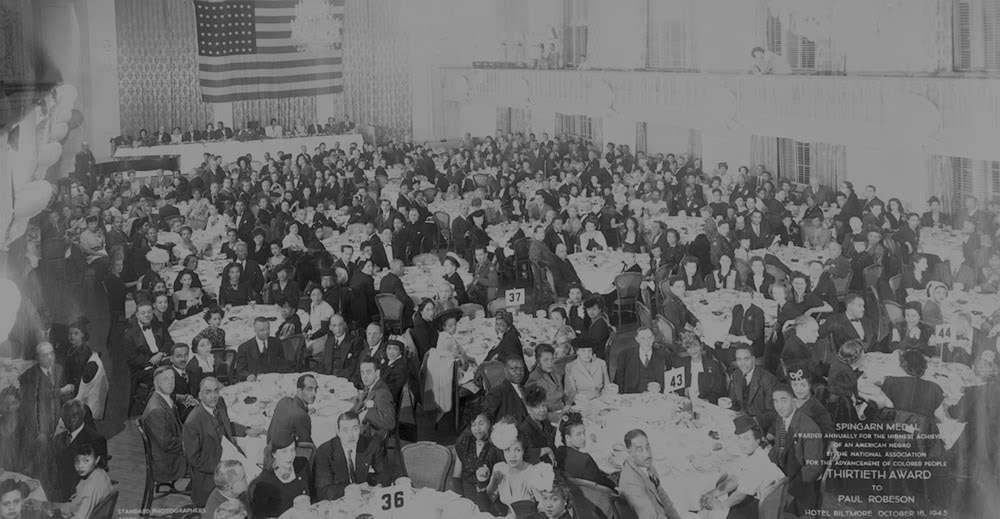
Paul Robeson "Hero of the Week"
Paul Robeson is being honored as the Moral Hero of the Week at
MoralHeroes.org. check it out.
 Paul Leroy Robeson, born in New Jersey in 1898, earned an academic scholarship to Rutgers College in 1915. After graduation, Robeson went on to Columbia Law School. He paid his fees there by playing with the National Football League for three years. However, after briefly working in a law firm, Robeson turned to theater. He acted in films and on stage, and sang in concert, winning international acclaim. Outspoken in his criticism of racism, Robeson was blacklisted in the 1940s and 1950s because he refused to repudiate his leftist affiliation. Nonetheless, the NAACP gathered this large group of people to celebrate their presentation of the Spingarn Medal to Robeson for his achievements in 1945.
MoralHeroes.org. check it out.
Subscribe to:
Posts (Atom)