Wednesday, December 31, 2008

Mychal Bell Shoots Himself

  I have thus far seen two versions of this story. One purports that young Bell shot himself out of despair relating to a recent shoplifting accusation and the other that he was cleaning a gun and accidentally shot himself.
 
 I have also noted that there are those who have already tried and convicted Bell once again with statements the the affect that some people never learn or that Al Sharpton has yet again backed the wrong person.
 
 Well I'm not personally ready to give up on young Myke Bell so easily,  he has been living under a lot of stress and he has also been subjected to the full force of the racist Louisiana legal system which would all to gladly throw him under a bus rather than give him the chance that a young white boy would get for similar offences.

 Hang in there Mychal, there are people out here who do want to see you get it together.


Tuesday, December 9, 2008

The Timbuctoo Manuscripts - Let's Not Forget Historical Media

The treasures of Timbuktu
Wealth of words | The belief that Africa had no written history has been disproven in the fabled centre that once was a seat of Islamic scholarship
Dec. 18, 2005. 01:00 AM
JOAN BAXTER
SPECIAL TO THE STAR TIMBUKTU, MALI

Time has not been kind to this once-great centre of civilization, which in the early 1500s inspired the Spanish explorer Leo Africanus to paint a picture of a learned, cultured and peaceful place where books were the main industry, where one literally walked on "gold."

Lured by this promise of riches, European explorers tried for centuries to find Timbuktu. By the time the first ones finally arrived in the 1800s, they found a desolate desert outpost not all that different from the sand-swept town of today, with no evidence of all the fabled wealth. Hence, the Western myth about a never-never place with little to offer the world — a myth that is about to be exploded.

Today, treasures are being unearthed here that are radically changing the way the world views Timbuktu, Africa and her history. They're called the "Timbuktu manuscripts" and they disprove the myth that Africa had no written history.

While many thousands have been recovered, there are still hundreds of thousands of manuscripts hidden away in wells and mud-walled storerooms in northern Mali. Huge collections have been passed down in families over many centuries, kept out of sight for fear that European explorers, and then French colonists, would abscond with them.

"Before, all the manuscripts were kept in our homes," says Abdelkader Haidara, who has inherited his family's collection of 9,000 written works dating back to the 16th century.

"Then, in 1993, I had an idea to open a private and modern library that would be open to everyone."

Thanks to funding from an American foundation, Haidara has been able to open his Mamma Haidara library and catalogue 3,000 of the manuscripts, some of which date back to the 1100s.

None of this would have been possible had not Henry Louis Gates Jr., chair of Harvard University's African and African-American studies department, visited Haidara and realized the importance of preserving these documents.

"When professor Gates came here and saw the storeroom full of these manuscripts written by African scholars centuries ago, he started to cry," says Haidara. "He wept like a child, and when I asked him why, he said he had been taught at school that Africa had only oral culture and that he had been teaching the same thing at Harvard for years and now he knew all that was wrong."

Read more...

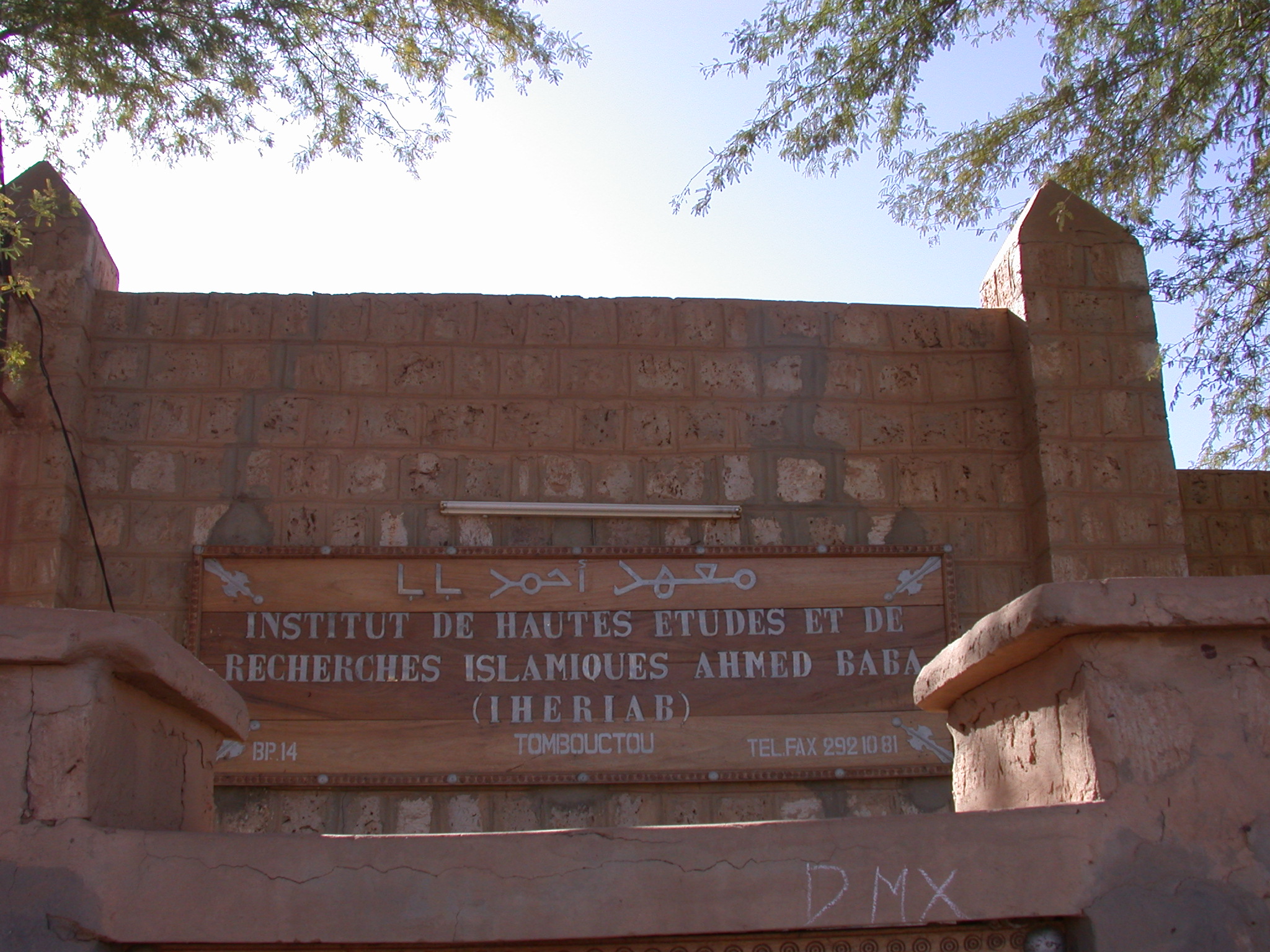
Ahmed Baba Institute

Libraries in the sand reveal Africa's academic past.

Researchers in Timbuktu are fighting to preserve tens of thousands of ancient texts which they say prove Africa had a written history at least as old as the European Renaissance.

Private and public libraries in the fabled Saharan town in Mali have already collected 150,000 brittle manuscripts, some of them from the 13th century, and local historians believe many more lie buried under the sand.

The texts were stashed under mud homes and in desert caves by proud Malian families whose successive generations feared they would be stolen by Moroccan invaders, European explorers and then French colonialists.

Written in ornate calligraphy, some were used to teach astrology or mathematics, while others tell tales of social and business life in Timbuktu during its "Golden Age," when it was a seat of learning in the 16th century.

"These manuscripts are about all the fields of human knowledge: law, the sciences, medicine," said Galla Dicko, director of the Ahmed Baba Institute, a library housing 25,000 of the texts.

  I hope you all find this info interesting  enough to do a followup. 
This is the kind of thing we should be after the "Black guy" in the "White House"
to support. The world needs to become more aware of Africa's history.
It's not enough to know that these texts exist, we have to be about the work of
spreading their contents. The following is an example of what we might expect 
to find in these manuscripts, among other data.


An 18th century Timbuctoo Account - part 1
Posted on January 31, 2008 by The Griot
The following are excerpts from;

AN ACCOUNT OF A JOURNEY FROM FAS TO TIMBUCTOO, PERFORMED IN OR ABOUT THE YEAR 1787, A.C. BY EL HAGE ABD SALAM SHABEENY.
_WITH NOTES, CRITICAL AND EXPLANATORY._By; JAMES GREY JACKSON,Printed by A. and R. Spottiswoode,Printers Street, London. 1820.
SITUATION OF THE CITY OF TIMBUCTOO.

On the east side of the city of Timbuctoo, there is a large forest,in which are a great many elephants. The timber here is very large. The trees on the outside of the forest are remarkable for having two different colours; that side which is exposed to the morning sun is black, and the opposite side is yellow. The body of the tree has neither branches nor leaves, but the leaves, which are remarkably large, grow upon the top only: so that one of these trees appears, at a distance, like the mast and round top of a ship.

Thursday, December 4, 2008

Sister Rosetta Tharpe

I discovered this while surfing Youtube.
Sister Rosetta Tharpe-Strange Things Happening Everyday... Recorded in 1944, this song has been considered by some the first rock and roll song, you be the judge


  It never ceases to amaze me just how far the internet has come
since I first started using it in the late 80s.  
 
 I was unaware of Sister Rosetta Tharpe until this morning and
I've been around for quite a while. I thought I'd share this with
the rest of you. I just have a quick wikipedia reference here but feel 
free to do your own research and add to this.


From Wikipedia, the free encyclopedia

Rosetta Tharpe (March 20, 1915 – October 9, 1973) was a pioneering Gospel singer, songwriter and recording artist who attained great popularity in the 1930s and 1940s with a unique mixture of spiritual lyrics and early rock accompaniment. She became the first great recording star of Gospel music in the late 1930s and also became known as the "original soul sister" of recorded music.

Willing to cross the line between sacred and secular by performing her inspirational music of 'light' in the 'darkness' of the nightclubs and concert halls with big bands behind her, her witty, idiosyncratic style also left a lasting mark on more conventional gospel artists, such as Ira Tucker, Sr., of the Dixie Hummingbirds. While she offended some conservative churchgoers with her forays into the world of pop music, she never left gospel music.

Birth name Rosetta Nubin
Born March 20, 1915
Origin Cotton Plant, Arkansas
Died October 9, 1973 (aged 58)

Sunday, November 23, 2008

Harlem Heritage Highlighted

I was sifting through iTunes recently and dug up in iTunes U.
a very interesting course called ; 

Harlem's Heritage -Harlem Digital Archive.
Instructor - Manning Marable

It includes a dozen podcasts in the form of lectures, that will prove very interesting to anyone interested in Black American history.

These podcasts can be downloaded freely and would make a rich source of material for anyone wishing to share this part of our history with children, discussion groups or however your imagination permits.


A dozen podcasts presented by Columbia University's Center for new media, teaching and learning. (CNMTL)

Taken from classes and events at Columbia University on and related to Harlem, these podcasts are part of the Harlem Digital Archive. A repository
for teaching and learning materials that can be taught in the University, libraries and Museums.

Professor Leith Mullings

Professor J. Yolande Daniels

Professor Samuel Roberts

Sandhya Shukla

Professor Kimberly Johnson

Professor Manning Marable

Professor Farah Jasmine Griffin

Professor David J. Maurrasse

Malcolm X's Political Thought and Legacy

Malcolm X, Women and Gender

Whose Book is This?

The Assassination of Malcolm X and it's Aftermath

This material is taken from the rich and extensive archive at Columbia University about 
Black Americana and Harlem in particular. 

The material found at Columbia on iTunes U is just the tip of the iceberg visit:


The Harlem Digital Archive:

A Television, Education, and Library Project
A collaborative project of
The Columbia Center for New Media Teaching and Learning
Intelligent Television
Digital Knowledge Ventures and
Columbia University Libraries


Friday, November 7, 2008

Obama is Elected the Community Work Must Continue

I am excited to have had the opportunity in my lifetime, to have witnessed the election of a Black man to the office of POTUS. As far as I can see looking around me, I am not alone. Black folks not just in the US but the world over, are charged up and inspired and expressing positive thoughts about themselves and the race as a whole. I've seen quite a few interviews where people are already saying that they feel like if he can do it they can likewise achieve their loftier goals.

I am a firm believer in the idea that things happen because people expect them to happen and thus take steps to bring about the reality.
On the other hand when people expect things to happen because others are going to make them come about, disappointment often follows.

If Obama does nothing else he has supplied us, at
least for the present with a focal point and a suitable mantra that everyone is capable of understanding (Yes We Can).

We are way behind on the scoreboard but for the moment the ball is in our possession I hope we don't get distracted and fumble right away.


excerpt
Community organizing redeemed

from Seattlepi.com

By AMY GOODMAN
SYNDICATED COLUMNIST

There are two key camps that feel invested in the Obama presidency: the millions who each gave a little, and the few who gave millions. The big-money interests have means to gain access. They know how to get meetings in the White House, and they know what lobbyists to hire. But the millions who donated, who volunteered, who were inspired to vote for the first time actually have more power, when organized.

Before heading over to Grant Park in Chicago, Obama sent a note (texted and e-mailed) to millions of supporters. It read, in part: "We just made history. And I don't want you to forget how we did it. ...