Amanishakheto
From Wikipedia,
Amanishakheto
Kushite Queen of Meroe

Bracelet from the tomb of Amanishakheto in Nubia.
Full name
Amanishakheto
Buried
Meroe (Beg. N 6)
Predecessor
Amanirenas
Successor
Amanitore
Amanishakheto was a Kandake of Nubia. She seems to have reigned from 10 BC to 1 AD, although most dates of Nubian history before the Middle Ages are very uncertain.
In Meroitic hieroglyphs her name is written as Amanikasheto (Mniskhte or (Am)niskhete). In Meroitic cursive she is referred to as Amaniskheto qor kd(ke) which means Amanishakheto, Qore and Kandake ("Ruler and Queen").[1]

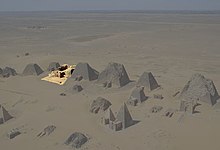
The Meroe pyramids, 6 is highlighted.
Amanishakheto is known from several monuments. She is mentioned in the Amun-temple of Kawa, on a stela from Meroe, and in inscriptions of a palace building found at Wad ban Naqa, from a stela found at Qasr Ibrim, another stela from Naqa and her pyramid at Meroe (Beg. no. N6).[1]
Amanishakheto is best known from a treasure of jewellery recovered in 1834 from her pyramid in Meroe by Italian explorer Giuseppe Ferlini. These pieces are now in the Egyptian Museum of Berlin and in the Egyptian Museum of Munich.
She is known for having defeated a Roman army sent by Augustus to conquer Nubia, having broken a favourable peace treaty.
Kandake or
Kentake, also
Candace, was the title for queens and queen mothers of the ancient African
Kingdom of Kush, also known as
Nubia and
Ethiopia.
- Then the Angel of the Lord said to Philip, Start out and go south to the road that leads down from Jerusalem to Gaza, which is desert. And he arose and went: And behold, a man of Ethiopia, an Eunuch of great authority under Candace, Queen of Ethiopians, who had the charge of all her treasure, and had come to Jerusalem to worship.[1]
The name Candace and its variants derive from the title Kandake.
Warrior queens?
Most scholars would dismiss the accounts of
Herodotus,
Strabo, and
Diodorus as compelling evidence to support the existence of women warriors in Africa, although all three ancient writers have proved accurate in the great majority of their testable observations about life in the centuries before Christ. As time proceeds, the evidence supporting the presence of a tradition of African women warriors grows in its persuasiveness.
[citation needed] An impressive series of Nubian warrior queens, queen regents, and queen mothers, known as kentakes (Greek: Candace "Candake"), are only appearing to the light of history through the ongoing deciphering of the
Meroitic script. They controlled what is now Sudan,Ethiopia, and parts of Egypt.
Bas-reliefs dated to about 170 B.C. reveal kentakes Shanakdakheto, dressed in armor and wielding a spear in battle. She did not rule as queen regent or queen mother but as a fully independent ruler. Her husband was her consort. In bas-reliefs found in the ruins of building projects she commissioned, Shanakdakheto is portrayed both alone as well as with her husband and son, who would inherit the throne by her death. The following African queens were known to the Greco-Roman world as the "Candaces": Amanishakhete, Amanitore, Amanirenas, Nawidemak, and Malegereabar.
[edit]Kandakes of Kush